


FotoGear LensNippon Kogaku | Nikon Nikkor Japan

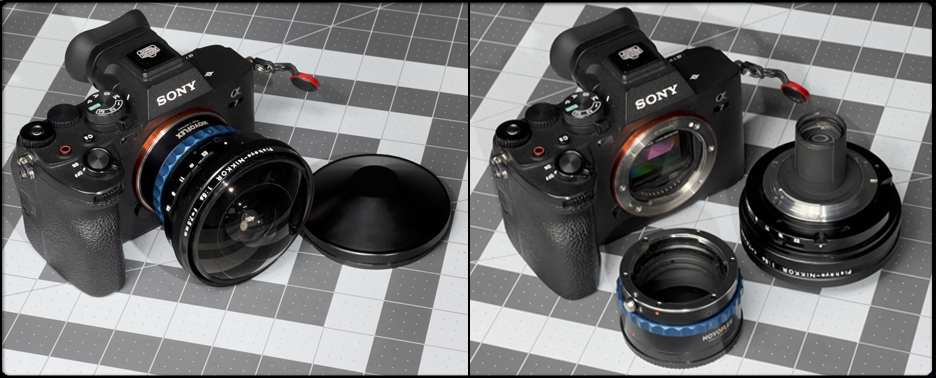
This is a collection of my vintage Nikon lenses. I have been collecting them for decades; most were ordered from Japan and are in mint condition. The correct lens hoods are also shown in the photos. Nikon or B+W Filters used. I use them by adapting them to a Sony a7iv and a7rii with a Novoflex adapter. Using them this way offers advantages Some of the lenses are rare, and some are over 60 years old. My first camera, which I bought in 1975, was a Nikon Nikkormat with a 50mm f/2.0 lens that I still own. The lenses are kept in a humidity cabinet and are free of fungus and dust.



Page One:
Fisheye • 7.5mm f5.6
 8mm f2.8
16mm f3.5
16mm f2.8
8mm f2.8
16mm f3.5
16mm f2.8 Ultra Wide • 15mm f5.6 QS C
15mm f3.5
18mm f3.5
18mm f4.0
20mm UD f3.5
20mm NKJ UD f3.5
20mm f4.0
20mm f2.8 Wide Angle • 24mm NKJ f2.8
24mm f2.0
2.8cm NKJ H f3.5 Chrome
28mm NKJ H f3.5
28mm NC f2.0
35mm NKJ S f2.8
35mm f1.4 Thorium Fifties • 5.0cm S f2.0
50mm H f2.0
50mm H.C. f2.0
50mm S f1.4
50mm SC f1.4
50mm f1.2
50mm f1.4
50mm f2.0 CC Fifties+ • 55mm NKJ S f1.2
55mm f1.2
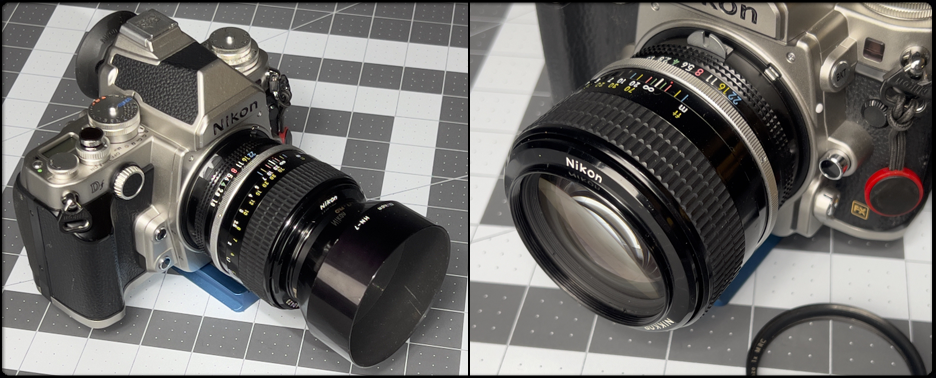
5.8cm f1.4 Portrait • 85mm f1.4
85mm H f1.8
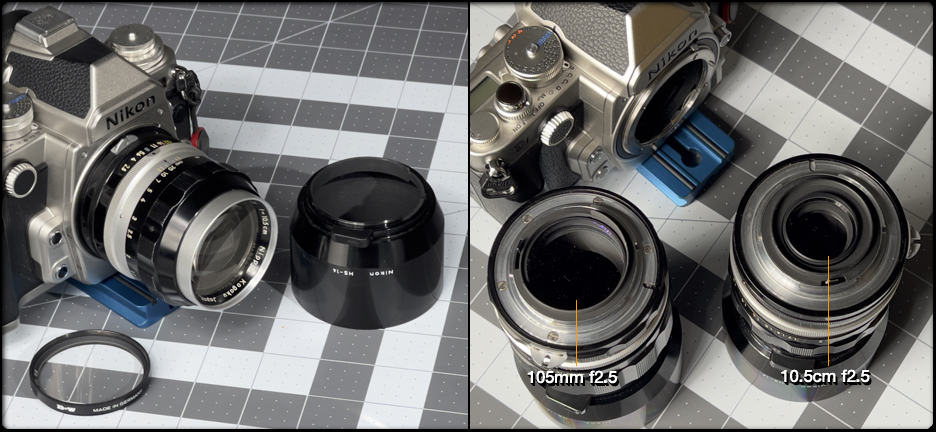
10.5cm f2.5 Sonnar
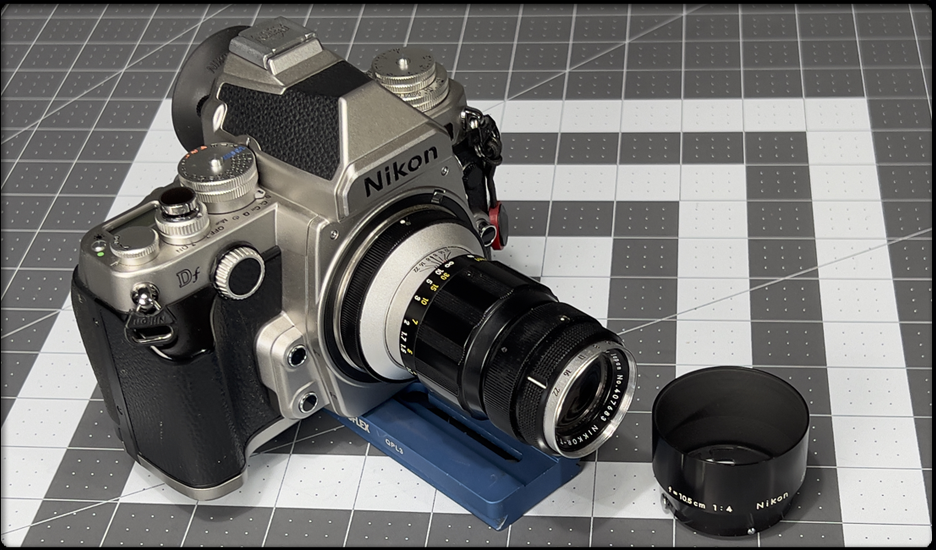
10.5cm f4.0 Nikkor-T
105mm P f2.5
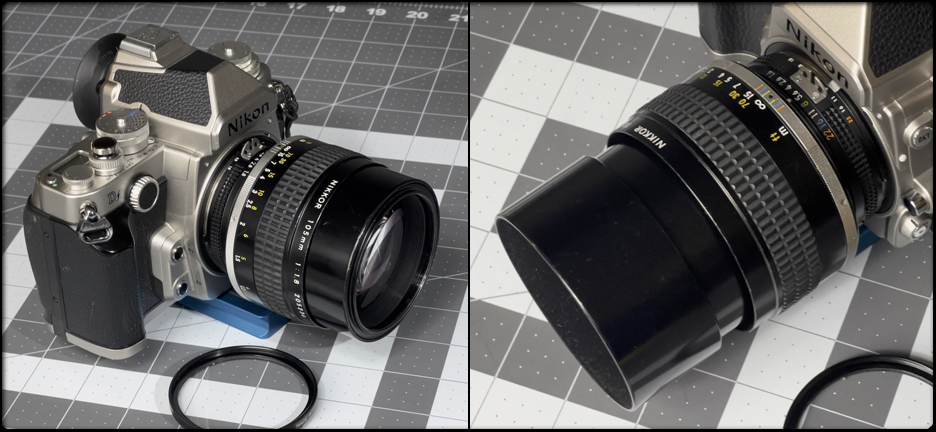
105mm f1.8 Telephoto 135 to 500 • 135mm Q f2.8
135mm Q f3.5
135mm f2.0
135mm f2.8
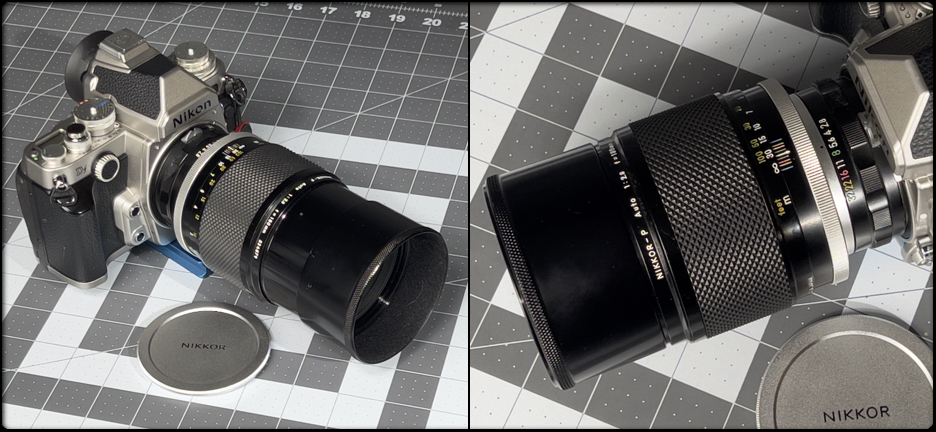
180mm P f2.8
180mm ED f2.8 
20.0cm f4.0
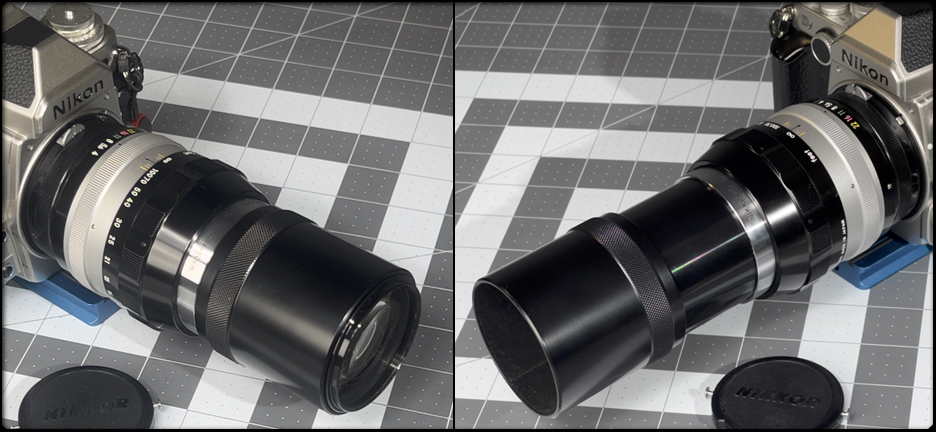
200mm f4.0
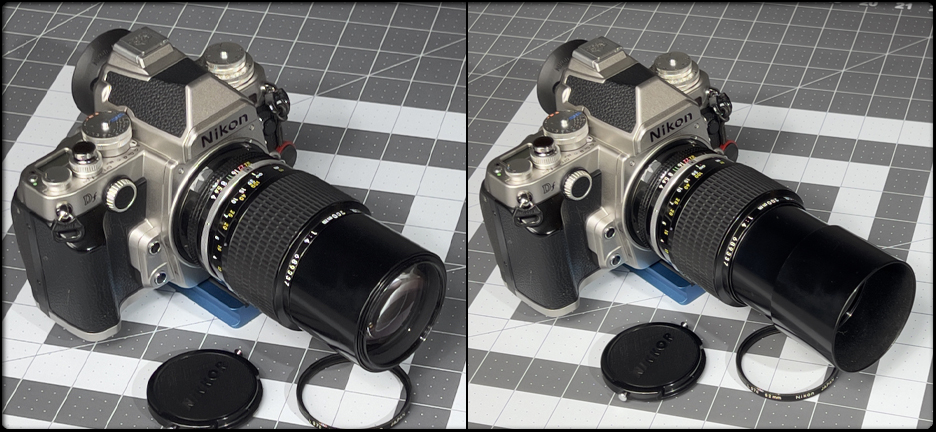
300mm ED IF f 2.8
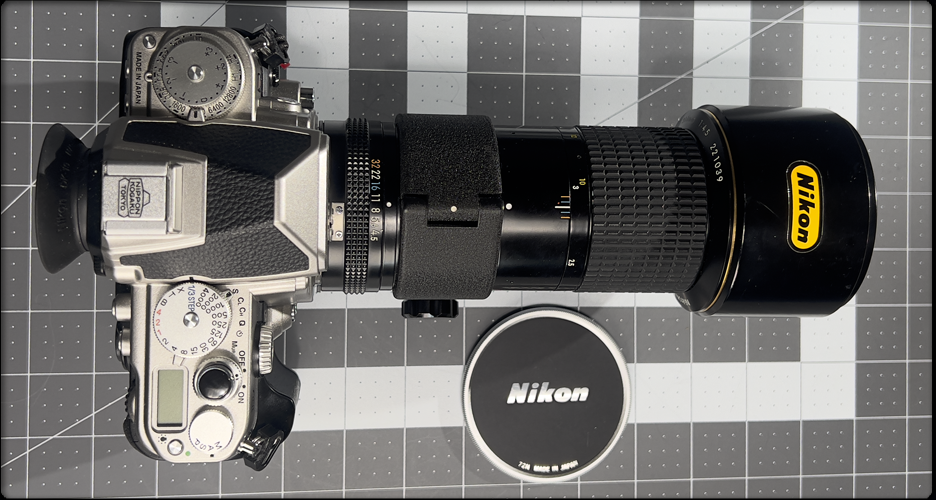
300mm f4.5 ED IF
300mm Q f4.5
300mm K f4.5 400mm ED f5.6
400mm KAI PC f5.6
500mm f4.0 IF ED Page Two:
Reflex • 50cm NKJ f5.0
500mm NKJ f8.0
500mm N f8.0
1000mm NKJ f11.0
1000mm Nikkor f11.0
Focusing Units • AU-1 and CU-1 + Rare CU-1 Cradle
Super-Tele • 400mm NKJ PC f4.5
600mm PC f5.6
800mm PC f8.0
1200mm PC f11.0
Tilt/Shift • 28mm PC Perspective Control f3.5
35mm NKJ PC Perspective Control f2.8
Micro • 55mm NKJ f3.5
55mm P f3.5
55mm f2.8
105mm f2.8 o
105mm f4.0 M
200mm f4.0 Micro
Zoom • 200-400mm f4.0 ED Rare
25~50mm f4.0
28~45mm f4.5
28~85mm f3.5 Macro
43~86mm f3.5 NKJ Zoom
Super Tele-Zoom • 50~300mm f4.5
50~300mm IF ED f4.5
85~250mm f9.5
200~600mm f9.5
Flat Field Macro • Rayfact MJ90 f4.0
LensScope • F Lens Converter
The Nikon Df was used to illustrate the lenses in my collection because it was designed to support various iterations of the Nikon F-mount, including non-AI (Pre-AI), AI, and AI-s lenses. It is currently the only Nikon DSLR that can natively mount and meter with non-AI lenses thanks to its collapsible coupling lever. While other DSLRs can use AI and AI-s glass, the Df provides the broadest compatibility across nearly every F-mount lens produced since 1959
.PDF Refrences Links:
• Nikomat FTN Nikon F2 Nikkor F Nikon F2 Manual Nikon AI
• System of Photography 1968 Nikon Lens 1988 CloseUp Nikkor Catalog
• Nikkor 180° Fisheye
1 • Rare Nikkor 180° Circular Fisheye 7.5mm f5.6
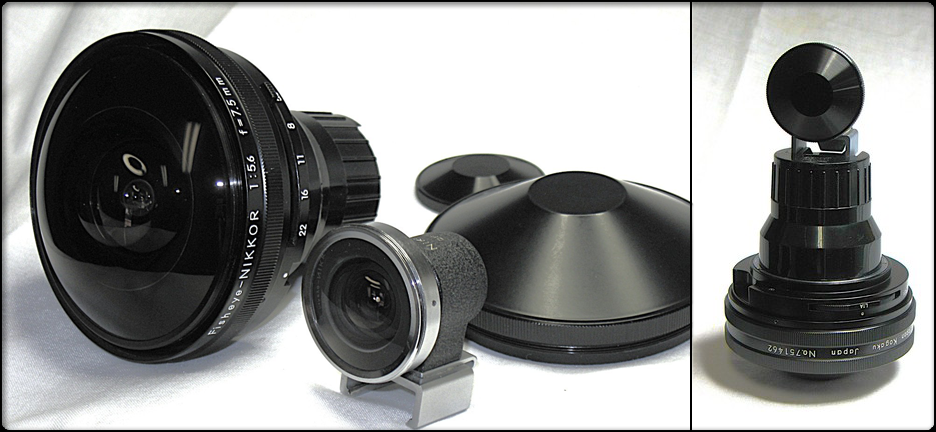
The Nippon Kogaku Fisheye-Nikkor 7.5mm f/5.6 is a vintage circular fisheye lens introduced in the mid-1960s (approximately 1965/1966) for the Nikon F system. It is highly regarded by collectors for its unique "poking" design and true 180° hemispherical perspective. The Nippon Kogaku Fisheye-Nikkor 7.5mm f/5.6 was introduced in 1966 as a faster and more refined replacement for the original 8mm f/8. It was one of Nikon's earliest interchangeable 180° circular fisheye lenses, staying in production until approximately 1970 when it was superseded by the more practical 8mm f/2.8. History & Development• Purpose: It was designed to provide a brightened aperture (f/5.6 vs f/8) and a slightly smaller 23mm image circle
• Mirror Lock-Up Requirement: Due to its "primitive" rear design that pokes deep into the camera body, it requires the camera's mirror to be locked up before mounting.
• Rarity: Approximately 2,500 units were produced, making it relatively rare but more common than some other extreme fisheyes like the 6mm or 10mm versions.
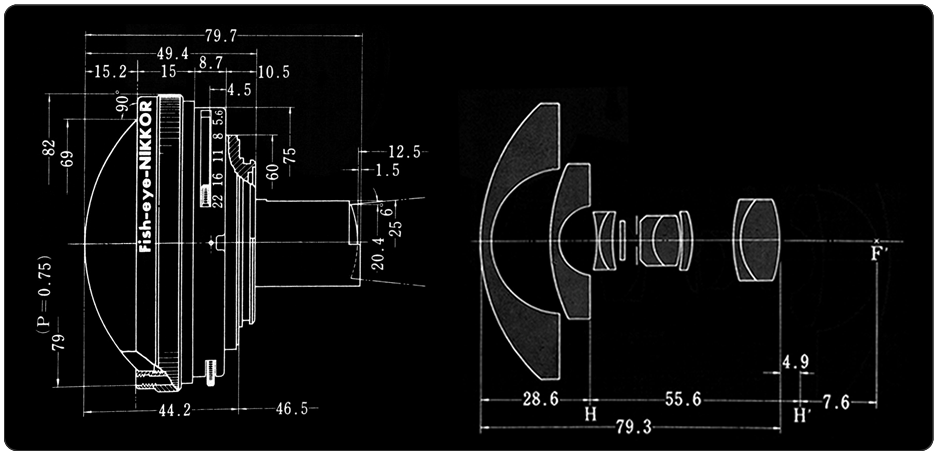
• Production Year: 1967 • FOV: 180° • Focusing: Fixed Focus (No focusing mechanism; extreme depth-of-field from approximately 20 inches to infinity).
• Built-in Filters: Includes a rotating internal turret with 6 filters: L1A (Skylight), Y48 (Medium Yellow), Y52 (Deep Yellow), O57 (Orange), R60 (Red), and XO (Light Green).
• Dimensions: 82mm x 80mm • Weight: 315g • Lens Hood N/A " • Aperture Scale: f5,68 to f22.0


2 • Rare Nikkor 180° Circular Fisheye 8mm f2.8
The Fisheye-Nikkor 8mm f/2.8 is one of Nikon's most iconic "exotic" lenses, famed for its massive dome-like front element and its status as the first circular fisheye that allowed for viewfinder framing and TTL metering without requiring a mirror lock-up. The Nikon Fisheye-Nikkor 8mm f/2.8 is an iconic circular fisheye lens that provides a full 180 degree field of view in every direction, projecting a 23mm circular image onto the film or sensor. Introduced in 1970, it was the first Nikon fisheye to feature an automatic diaphragm and did not require mirror lock-up, allowing for accurate framing through the viewfinder. • Production Year: 1977–1982 • FOV: 180° • Min Focus:12.0" • Aperture Scale: f5.6 to f22.0 • Filters: 5 built-in (Skylight/L1BC, Y48, Y52, O56, R60)
• Dimensions: 123mm x 139mm • Weight:1100g • Lens Hood N/A

• Ulanzi VF01 Ground Level Viewfinder
 Key Features & Specifications
  Optical Design: Features a 3-element, 3-group high-transmission lens that provides a crisp, distortion-free view through fine ground glass.
  Framing Options: Designed with a native 28mm full-frame field of view and includes switchable 35mm and 50mm bright framelines for precise composition.


  • Magnetic Lens Hood

  • 45.2 x 38.2 x 44.2 mm

• 63g 
3 • Rare Nikkor 170° Full Frame Fisheye 16mm f3.5
The Fisheye-Nikkor 16mm f/3.5 is historically significant as Nikon's first full-frame (diagonal) fisheye lens designed to fill the entire rectangular 24×36mm film frame. Produced between 1973 and 1979, it is highly regarded by optics experts for its superior corner-to-corner sharpness compared to later f/2.8 versions.
• Market Shift: Before this lens, Nikon only produced circular fisheye lenses, which left dark borders around a central circular image and served scientific markets.
• Design Purpose: Nikon launched the 16mm f/3.5 to cater directly to creative, consumer photographic applications.
• 1973–1976: Launched as the Fisheye-Nikkor 16mm f/3.5 Auto (Pre-AI).
• 1976–1977: Updated to the "New" Nikkor version with modernized rubber grip styling.
• 1977–1979: Released as the native AI version featuring an automatic aperture coupling system.
• Legacy: Production ceased in 1979 when Nikon replaced it with the faster, but structurally distinct, 16mm f/2.8 AI-s lens.
•1973-76 (AI Version): Nikon released the first 16mm f/2.8, replacing the older f/3.5 model. It maintained a design that would remain largely unchanged for decades.
• 1982 (AI-s Version): Updated with the AI-s coupling system, featuring improved lens coatings and a smaller focusing ring.
• Production Year: 1983 • FOV: 170° • Min Focus: 12.0" • Aperture Scale: f3.5 to f22 • Filter Turret: Sky Normal, Y48/O5, R60 (Red), and L37C/A12
• Dimensions: 68mm x 60.5mm • Weight: 340g • Lens Hood: Built-in petal-shaped
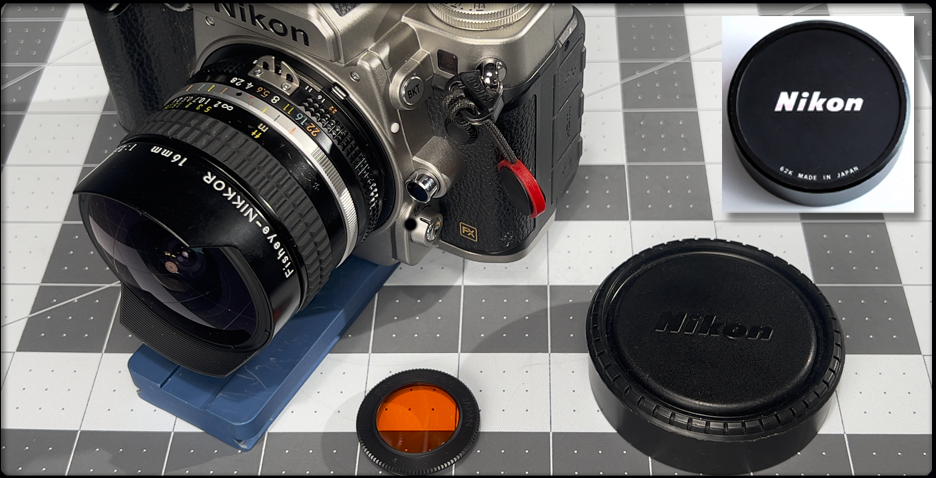
4 • Nikkor 180° Full Frame Fisheye 16mm f2.8
The Nikkor 16mm f/2.8 series represents Nikon's primary full-frame fisheye line, offering a dramatic 180° diagonal field of view that fills the entire 35mm frame. Nikon's journey with 16mm fisheye lenses began with the f/3.5 version (170° view) before evolving into the faster f/2.8 models that standardalized the 180° view.•1979 (AI Version): Nikon released the first 16mm f/2.8, replacing the older f/3.5 model. It maintained a design that would remain largely unchanged for decades.
• 1982 (AI-s Version): Updated with the AI-s coupling system, featuring improved lens coatings and a smaller focusing ring.
• Production Year: 1983 • FOV: 180° • Min Focus: 12.0" • Aperture Scale: f2.8 to f22 • Filters: 39mm Rear - L1BC, 056, A2, and B2
• Dimensions: 63.5mm x 62.5mm • Weight: 310g • Lens Hood: Built-in petal-shaped
• Nikkor UltraWide
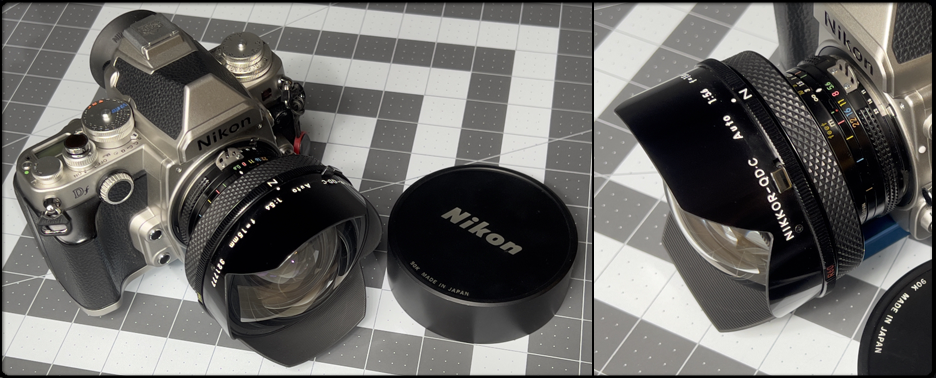

5 • Nippon Kogaku Ultra Wide 15mm f5.6 QD C
The Nikon Nikkor-QD.C 15mm f/5.6 was a landmark in ultra-wide angle photography, representing Nippon Kogaku's ambition to create a rectilinear (non-distorting) lens that could rival the perspective of a fisheye.• Early Prototypes: The lens was first announced at Photokina in 1970 but faced a long development cycle. Before its official release, a non-existent "15mm f/5.6 NIKKOR-PD" appeared in 1972 catalogs as a "carrot on a stick" for professionals; this version had a different 15-element design that was never produced.
• Official Release (1973): The final version, using 14 elements, launched in March 1973. At the time, it was the widest non-fisheye lens Nikon had ever mass-produced, filling a massive gap in their lineup which previously topped out at 20mm.
• Designer: The lens was designed by Mr. Ikuo Mori, a legendary Nikon optical engineer who also designed the famous 13mm f/5.6 and 18mm f/4 lenses. He utilized early large-scale computer simulations to perfect the complex optical formula
• Production Year: 1979 • FOV: 110.5° • Min Focus:12.0" • Aperture Scale: f5.65 to f22.0 • Filters:Built-in N, Y48, O56, R60 (part of the lens' optical system)
• Dimensions: 92mm x 76.5mm • Weight: 700g • Lens Hood: Built-in petal-shaped

6 • Nikkor Ultra Wide 15mm f3.5
The Nikon Nikkor 15mm f/3.5 is a legendary ultra-wide manual focus lens known for its professional-grade build and exceptional rectilinear accuracy. Unlike fisheye lenses, it keeps straight lines straight, making it a favorite for architectural and real estate photography.• Optics: 14 elements in 11 groups featuring Nikon's Close-Range Correction (CRC) system, which maintains sharpness even at its minimum focus distance.
• Angle of View: A massive 110° diagonal, nearly double that of a standard 35mm wide-angle lens.
• Focus & Aperture: Manual focus with a minimum focus distance of 0.3m (1 ft). Aperture ranges from f/3.5 to f/22 via 7 iris blades.
• Filters: Four 39mm filters: Skylight (L1Bc), Orange (O56), Light Amber (A2), and Light Blue (B2).
• Build: Features an all-metal black barrel with a built-in scalloped lens hood. It weighs approximately 630g (22.2 oz).
• Production Year: 1979 • FOV: 110° • Min Focus:12.0" • Aperture Scale: f3.5 to f22.0 • Filters: 39mm Rear - L1BC, 056, A2, and B2
• Dimensions: 94mm x 90mm • Weight: 630g • Lens Hood: Built-in petal-shaped

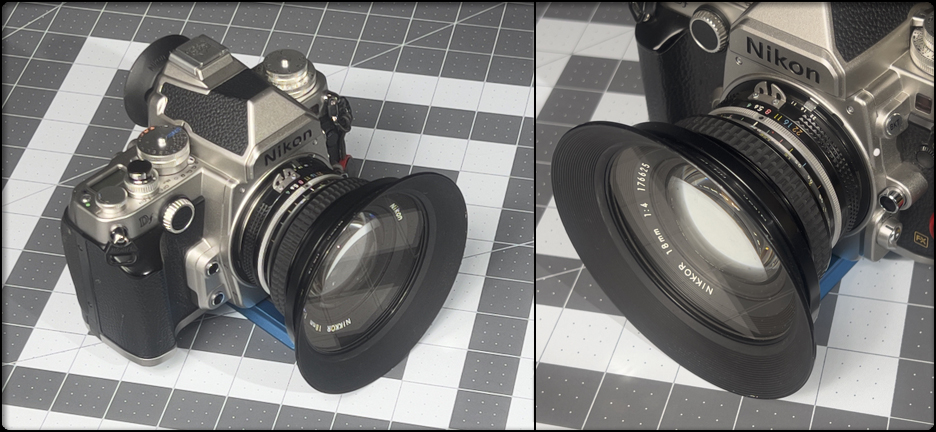
7 • Nikkor Ultra Wide 18mm f3.5
The Nikkor 18mm f/3.5 is a classic ultra-wide manual focus prime lens released by Nikon in February 1982. It replaced the earlier f/4.0 version and was produced as both an AI and AI-S lens, though the AI-S version is more common today.• Successor to f/4: This lens was a complete redesign of the Nikkor 18mm f/4, which had been sold since 1975.
• Key Upgrade: The f/3.5 version introduced the Close Range Correction (CRC) system, which significantly improved optical performance.
• Production Era: Production began in 1982 and continued for over two decades; the AI-S version was the standard from 1982 through the early 2000s.
• Production Year: 1982 • FOV: 100° • Min Focus: 10.0" • Aperture Scale: f3.5 to f22 • Filters: 72mm
• Dimensions: xxmm x xxmm • Weight:35g • Lens Hood: HK-9
8 • Nikkor Ultra Wide 18mm f4.0
The Nikkor 18mm f/4 was Nikon's first 18mm lens, introduced in November 1974. It was a landmark ultra-wide-angle lens because it was the widest rectilinear Nikkor at the time that could accept front-mounted 86mm filters. Designed by Ikuo Mori, the lens was highly regarded for its compact size and high performance, remaining in production for approximately 13 years across two major versions before being replaced by the 18mm f/3.5 in 1982.• New Nikkor (Non-AI): Debuted in November 1974 (released February 1975). It introduced Nikon Integrated Coating (NIC) multi-layering to the 18mm focal length.
• AI Nikkor: Released in June 1977, this version added the Automatic Maximum Aperture Indexing (AI) ring for better compatibility with newer meter coupling systems.
• Legacy: It is particularly noted by vintage collectors for its infrared (IR) performance, as it typically does not produce a "hot spot".
• Production Year: 1974 • FOV: 100° • Min Focus:12.0" • Aperture Scale: 4.08 to f22.0 • Filters: 6mm screw-in (or Series 9 with HN-15 hood)
• Dimensions: 89mm x 58.5mm • Weight: 3250g
 9 • Nikkor UD Wide 20mm f3.5
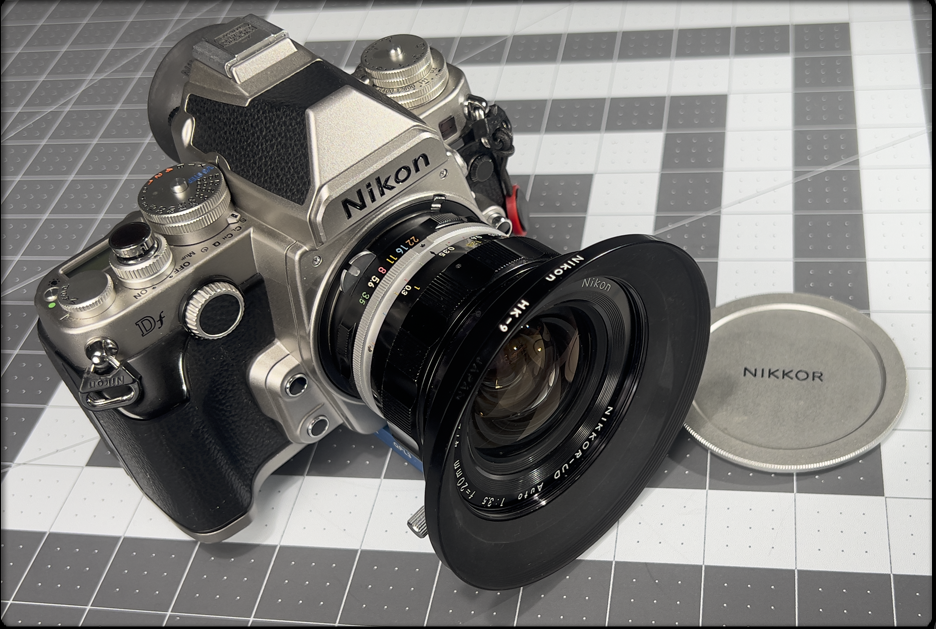
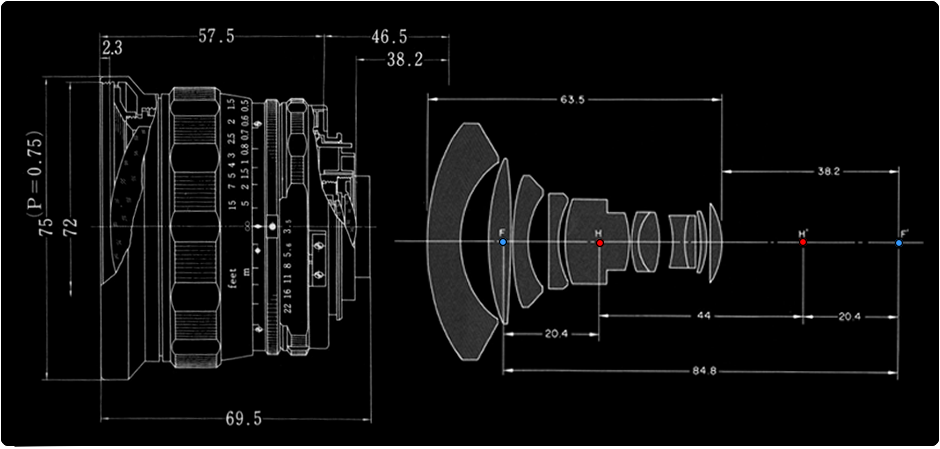
The Nikkor-UD Auto 20mm f/3.5 (1967–1974) was Nikon's first 20mm lens and its first SLR ultra-wide that did not require mirror lockup. It was a landmark design because it allowed photographers to see the actual 94° field of view directly through the viewfinder for the first time. • Release: Introduced in November 1967 (some sources cite 1968) for the Nikon F system.
• The "UD" Name: The suffix stands for its element count—U (Unus/1) and D (Decem/10) for a total of 11 elements.
• Innovation: Before this lens, Nikon's widest SLR lens (the 21mm f/4) protruded into the camera body, requiring the mirror to be locked up.
• Legacy: Approximately 40,000 units were produced before it was succeeded in 1974 by the more compact 20mm f/4.
• Production Year: 1974 • FOV: 94° • Min Focus: 12.0" • Aperture Scale: f3.5 to f22 • Filters:72mm
• Dimensions: 57.5mm x 75mm • Weight: 390g • Lens Hood: HN-9
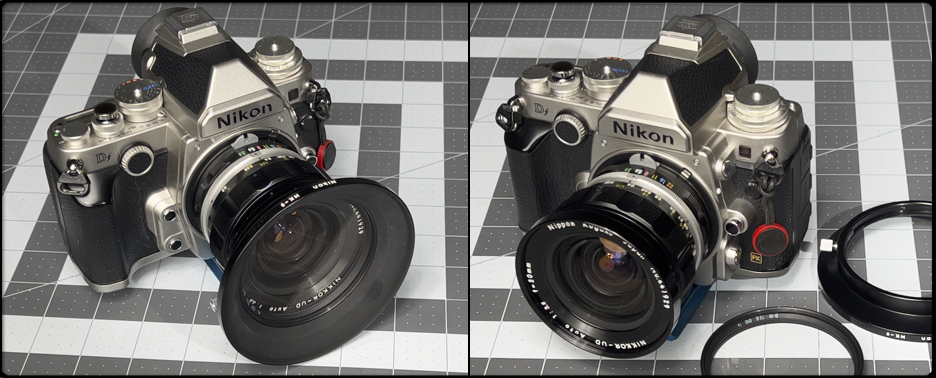
10 • Nippon Kogaku UD Wide 20mm f3.5
The Nippon Kogaku Nikkor-UD Auto 20mm f/3.5, introduced in November 1967, was Nikon's first retrofocus 20mm lens for the F-mount. It was a landmark achievement because, unlike its predecessor (the 21mm f/4 Nikkor-O), it did not require mirror lock-up, allowing photographers to frame and focus directly through the SLR viewfinder.• A "World First": At its launch, it was the widest non-fisheye lens available for Nikon SLRs that allowed for normal through-the-lens viewing.
• The "UD" Name: The designation "UD" refers to the optical formula. In Latin, U stands for unus (one) and D for decim (ten), totaling 11 elements.
• Production Era: Approximately 40,000 units were manufactured between 1967 and 1974. Early versions are marked "Nippon Kogaku Japan
• Successors: It was eventually replaced in 1974 by the much smaller, though slower, Nikkor 20mm f/4.
• Production Year: 1974 • FOV: 94° • Min Focus: 12.0" • Aperture Scale: f3.5 to f22 • Filters:72mm
• Dimensions: 57.5mm x 75mm • Weight: 390g • Lens Hood: HN-9
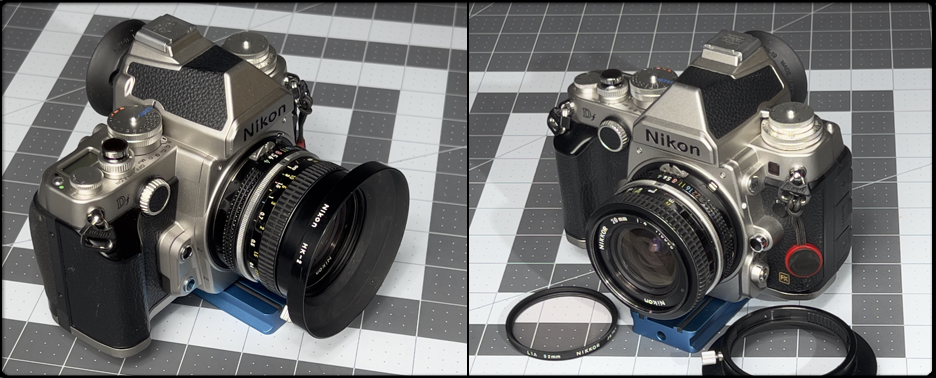
11 • Nikkor Wide 20mm f4.0
The Nikkor 20mm f/4.0 was introduced in November 1974 to provide a compact ultra-wide alternative to the large and heavy Nikkor-UD 20mm f/3.5. It remains one of the smallest ultra-wide lenses ever produced by Nikon, often compared to a "thick body cap" due to its minimal profile. Replacement of the f/3.5 UD: Prior to this lens, Nikon's 20mm offering (the UD f/3.5) was significantly larger and used 72mm filters. The f/4 versionreduced the filter size to a standard 52mm, greatly improving portability for hikers and landscape photographers.
• 1974–1977: Original "New-Nikkor" (K) version with a non-AI mount.
• 1977–1978: Updated to the AI (Automatic Indexing) system.
• 1978: Production ended as it was replaced by the Nikkor 20mm f/3.5 AI, which used a newer optical system but maintained the 52mm filter size.
• Rarity: Fewer than 35,000 units were made across all variants, with some estimates as low as 23,000 total lenses.
• Production Year: 1974 • FOV: 94° • Min Focus: 12.0" • Aperture Scale: f4.0 to f22 • Filters: 52mm
• Dimensions: xxmm x xxmm • Weight: 210g • Lens Hood: HK-6
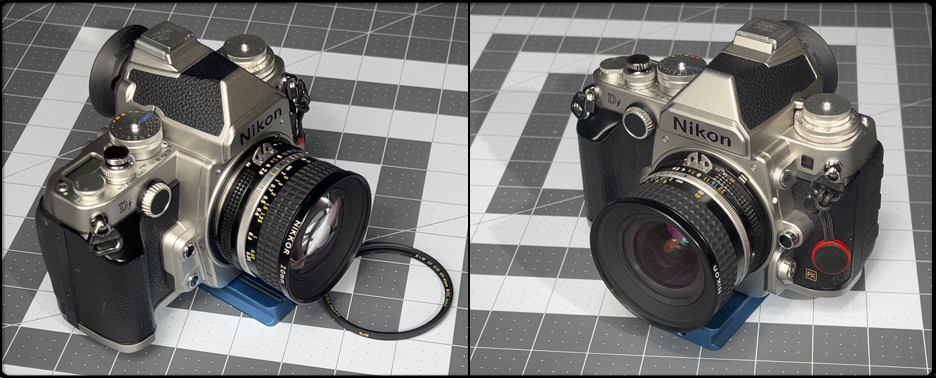
12 • Nikkor Wide 20mm f2.8
The Nikkor 20mm f/2.8 has been a staple in Nikon’s ultra-wide lineup since the mid-1980s, primarily known for its incredibly compact size and consistent optical performance across multiple generations. All versions share the same core optical design and are valued for their 94° ultra-wide field of view on full-frame cameras. Nikon evolved this lens through three primary iterations, maintaining the same 12 elements in 9 groups optical formula throughout:• Nikkor 20mm f/2.8 AI-s (1984–Present): Introduced to replace the slower f/3.5 version, this manual-focus classic added Close Range Correction (CRC) .
• AF Nikkor 20mm f/2.8 (1989–1994): The first autofocus version, utilizing the same optics as the AI-s but in an autofocus-capable body.
• Production Year: 0000 • FOV: 000° • Min Focus:00.0" • Aperture Scale: f2.8 to f22.0 • Filters: 39mm Rear - L1BC, 056, A2, and B2
• Dimensions: 000mm x 000mm • Weight: 0000g • Lens Hood N/A
• Nikkor Wide
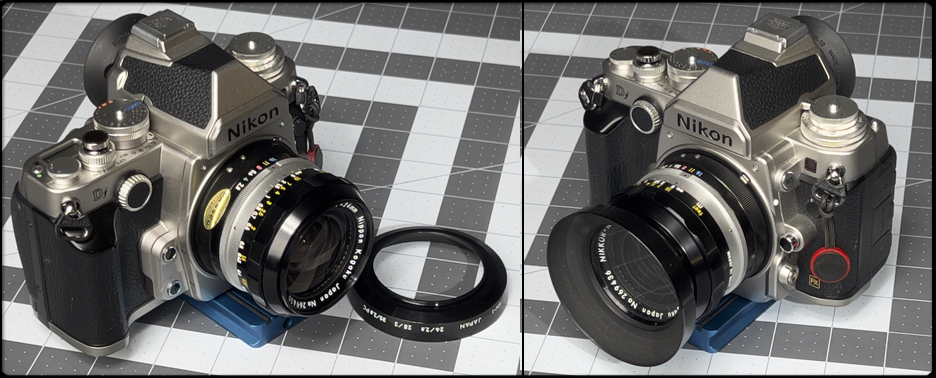
13 • Nippon Kogaku N Wide 24mm f2.8
The Nippon Kogaku Nikkor-N Auto 24mm f/2.8, first released in 1967, was a landmark in lens history as the world’s first 35mm wide-angle lens to feature a Close-Range Correction (CRC) system. This floating element design allowed the lens to maintain high sharpness even at its minimum focusing distance of 0.3m. Historical Variations The 24mm f/2.8 underwent several iterations under the Nippon Kogaku brand before transitioning to the modern Nikon branding:• Nikkor-N Auto (1967–1972): The original version featuring 9 elements in 7 groups. It was single-coated and is often identified by the "Nippon Kogaku Japan".
• Nikkor-N.C Auto (1972–1975): Added multi-layer coating (denoted by the "C") to improve flare resistance and color reproduction.
• "New" Nikkor / K-Type (1975–1977): Updated with a modern cosmetic design, including a rubber focusing ring, while retaining the original 9-element/7-group optics.
• AI and AI-S Versions (1977 onwards): These later models introduced a redesigned optical formula (9 elements in 9 groups) and integrated auto-indexing.
• Production Year: 1970 • FOV: 84° • Min Focus: 12.0" • Aperture Scale: f2.8 to f16 • Filters: 52mm
• Dimensions: 92.1mm x 64.5mm • Weight: 290g • Lens Hood: HN-1

14 • Nikkor Wide 24mm f2.0
The Nikkor 24mm f/2.0 was Nikon's fastest 24mm prime lens for over 30 years, serving as a staple for photojournalists and low-light photographers from the late 1970s until the release of the f/1.4G AF-S in 2010. It is highly regarded for its compact all-metal construction and the inclusion of Nikon’s Close Range Correction (CRC) system, which maintains sharpness even at its minimum focusing distance of 0.3 meters.• Initial Release (1977): The lens was first introduced in October 1977 as an AI (Aperture Indexing) version.
• Production Run: It enjoyed a remarkably long production life, officially manufactured until 2005 and sold as new until roughly 2007.
• Production Volume: Approximately 65,000 units were produced in total—roughly 20,000 AI versions and 45,000 AI-S versions.
• AI-S Update (1981): In late 1981, it was updated to the AI-S standard. While the optical design remained identical, the AI-S version featured refined mechanics, such as an aluminum lens fastening ring (replacing solid chrome) and a shorter focus throw.
• Production Year: 1982 • FOV: 84° • Min Focus: 12.0" • Aperture Scale: f2.0 to f22 • Filters: 52mm
• Dimensions: xxmm x xxmm • Weight: 305g • Lens Hood: HK-2
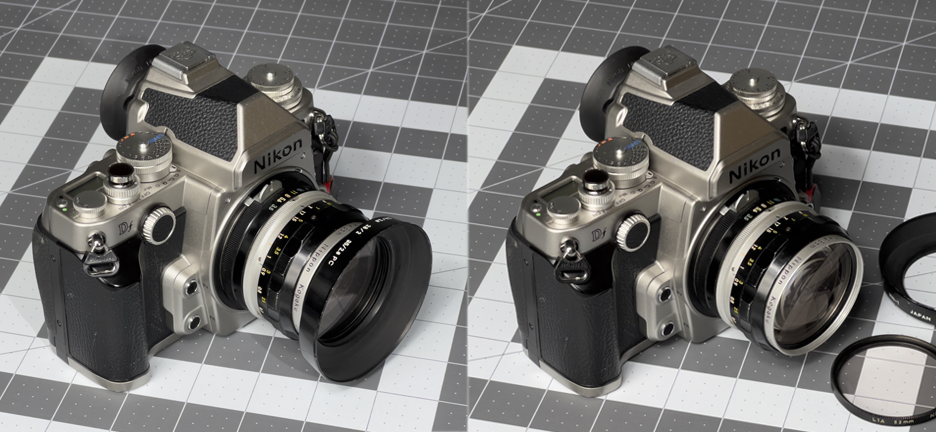
15 • Nippon Kogaku Wide 2.8cm f3.5 Chrome
• The early, chrome-finished models are made of brass, offering an extremely solid "dense" feel.• Known for a very long focus throw
• Despite the slow f/3.5 speed, it is known for high contrast and sharp images
• Production Year: 1960 • FOV: 74° • Min Focus: 24.0" • Aperture Scale: f3.5 to f16 • Filters: 52mm
• Dimensions: 62.5mm x 54mm • Weight: 215g • Lens Hood: HN-2

16 • Nippon Kogaku Wide H 28mm f3.5
The Nippon Kogaku Nikkor-H Auto 28mm f/3.5 was a landmark wide-angle lens released in March 1960, specifically designed for the Nikon F SLR system. It was the first 28mm lens for the Nikon F and played a critical role in establishing the SLR as a versatile professional tool by overcoming common wide-angle optical issues like coma and flaring through a refined retrofocus design.• Design Origin: Developed by optical engineer Zenji Wakimoto, this lens utilized a 6-element retrofocus design to accommodate the mirror box of the Nikon F. Wakimoto famously refined the configuration to significantly reduce coma without increasing distortion.
• Historical Predecessor: Before the SLR version, Nippon Kogaku produced a non-retrofocus W-Nikkor.C 2.8cm f/3.5 for rangefinder (S-mount) and Leica Thread Mount (LTM) cameras starting in 1952. •◦ 1960–1967: Lenses were marked in centimeters (2.8cm) and "Nippon Kogaku Japan".
• 1968: Markings changed to millimeters (28mm), and the "Nippon Kogaku" name was eventually replaced by "Nikon" around 1971.
• 1973: Introduction of the Nikkor-H·C version, which featured modern multi-coating for improved contrast and flare resistance.
• Late 1970s–1980s: Updated to AI and eventually AI-S versions before being discontinued around 1983.
• Production Year: 1970 • FOV: 74° • Min Focus: 24.0" • Aperture Scale: f3.5 to f16 • Filters: 52mm
• Dimensions: 62.5mm x 54mm • Weight:215g • Lens Hood: HN-2
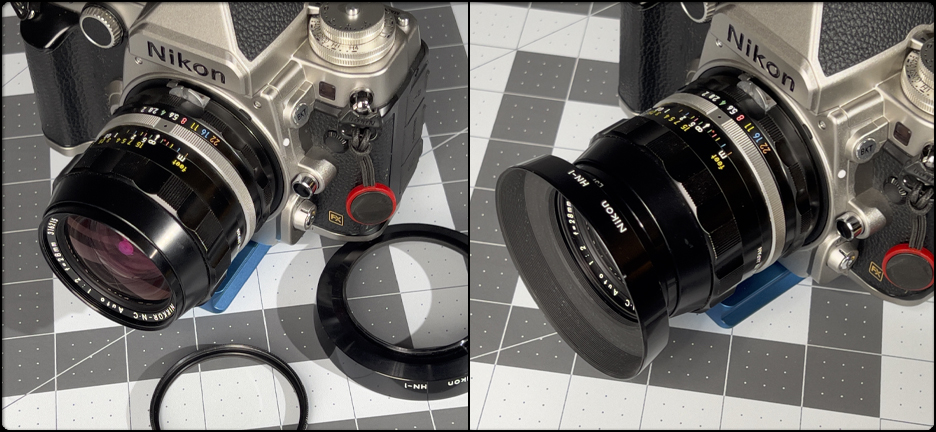
17 • Nikkor NC Wide 28mm f2.0
The Nikkor-N.C Auto 28mm f/2.0 is a classic manual-focus wide-angle lens known for its advanced optical design and fast maximum aperture for its era. Introduced in the early 1970s, the "N.C" designation specifically identifies it as the multicoated version of the original Nikkor-N.•Original Release (1970): The first version, the Nikkor-N Auto 28mm f/2, was one of the fastest lenses in its class, enabling photography in extremely dim light.
•N.C Designation (1973–1975): The "N" stands for "ennea" (nine elements), and the "C" indicates Nikon Integrated Coating (NIC), a multicoating process that improved contrast and reduced flare.
•Continued Legacy: The optical design was so successful it remained largely unchanged through subsequent "K" (1975), AI (1977), and AI-S (1981) versions until the series ended production in 2005.
• Production Year: 1973 • FOV: 24° • Min Focus: 12.0" • Aperture Scale: f2.0 to f22 • Filters: 52mm
• Dimensions: 64.5mm x 70mm • Weight: 345g • Lens Hood: HN-1
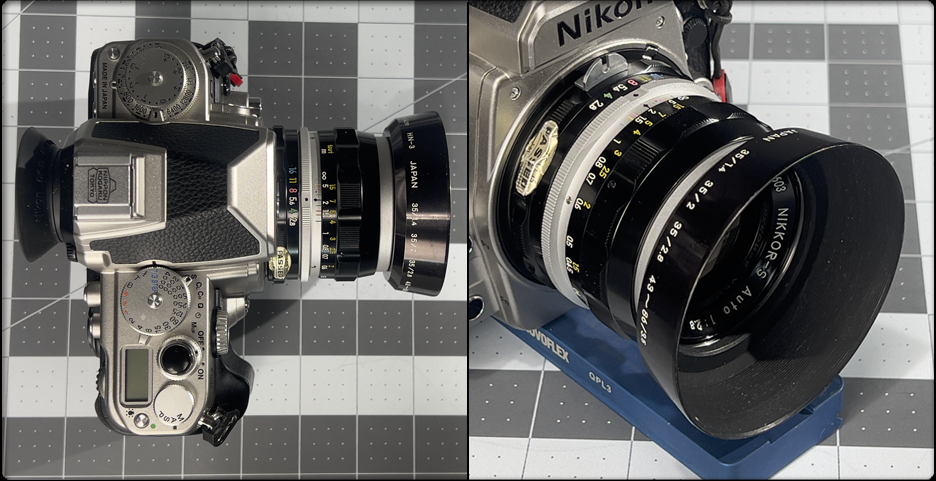
18 • Nippon Kogaku S Wide 35mm f2.8
The Nippon Kogaku Nikkor-S Auto 35mm f/2.8 (often marked as 3.5cm) was a foundational wide-angle lens for the Nikon F system, first released in 1959. Known for being one of the lightest and most economical entries into wide-angle photography, it underwent several significant optical redesigns during its production life. The lens is primarily categorized into two distinct early versions, despite carrying the same "Nikkor-S Auto" name:•Version 1 (1959–1962): Released two months after the Nikon F camera, this original version used a 7-element in 5-group design. It is typically identified by focal length markings in centimeters (3.5cm). It was a complex, early retrofocus design that was difficult to manufacture and is considered optically inferior to later versions due to specific aberrations.
• Version 2 (1962–1974): Often called the "Mark II," this version introduced a significantly improved 7-element in 6-group formula. This design adopted a "master lens" similar to a Gauss type to better correct spherical aberrations and coma. These lenses are marked in millimeters (35mm).
• Later Successors: In 1975, Nikon released a "New Nikkor" version with a 6-element/6-group design, followed by AI and AI-S versions that eventually moved to a 5-element/5-group configuration.
• Production Year: 1971 • FOV: 62° • Min Focus: 12.0" • Aperture Scale: f2.8 to f16 • Filters: 52mm
• Dimensions: 62.5mm x 57.5mm • Weight: 200g • Lens Hood: HN-3
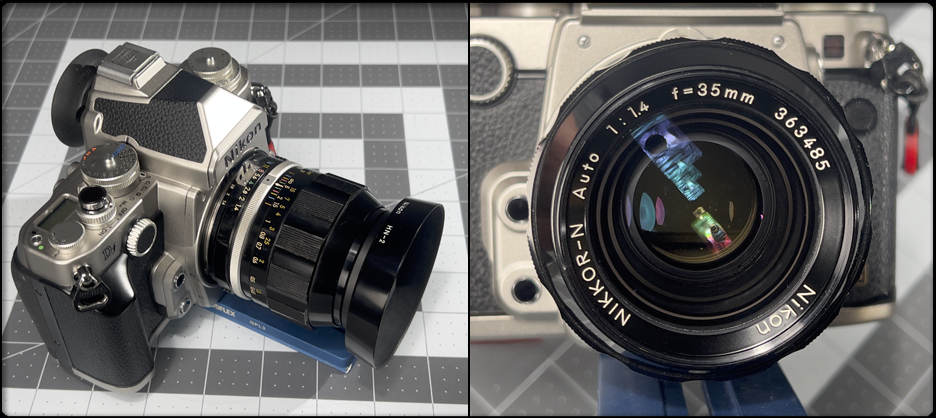
19 • Nikkor N Wide 35mm f1.4 Thorium
The Nikkor-N Auto 35mm f/1.4, introduced in 1970, is a landmark lens in Nikon's history as the first Nikkor to be fully multicoated and the fastest 35mm lens ever produced for the Nikon F-mount. Often nicknamed the "Atomic Nikkor" or "Atom-lens," it is famous for containing thorium-infused glass elements.• Radioactive Glass: Thorium oxide was added to the glass to achieve a high refractive index while maintaining low dispersion, which was a common high-performance optical design choice in the late 1960s and early 1970s.
• Aging Characteristics: Over decades, the thorium elements often develop a distinct yellow or amber tint due to radiation damage. This can be partially "bleached" out by exposing the lens to bright UV light or sunlight for several weeks.
• Thorium Timeline: Thorium glass was used in the earliest versions (serial numbers 350001 through roughly 376927), including the 9-aperture blade "N" series and some 7-blade "N.C" versions. It was phased out when the "New Nikkor" (K) series was introduced in the mid-1970s.
• Innovations: It was only the second Nikkor to feature Close-Range Correction (CRC), a floating element system that maintains sharpness at both infinity and its close-focus distance.
• Production Year: 1972 • FOV: 62° • Min Focus: 12.0" • Aperture Scale: f1.4 to f16 • Filters: 52mm
• Dimensions: 66.5mm x 74.5mm • Weight:415g • Lens Hood: HN-3
• Nikkor Fifties
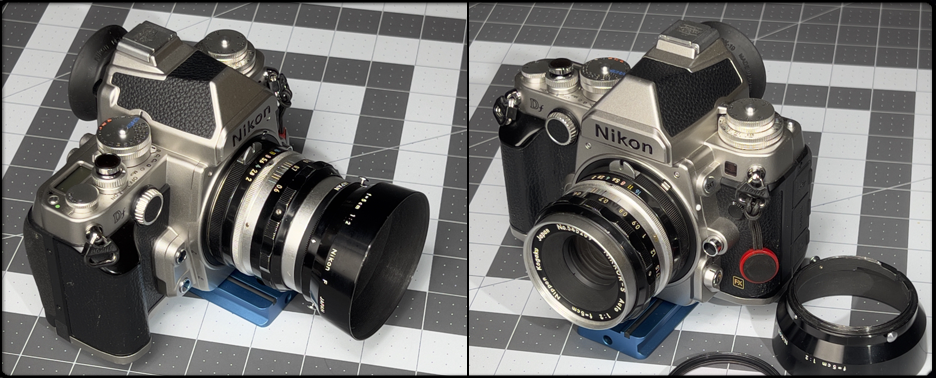
20 • Nikkor Fifties 5.0cm f2.0
The Nikkor 5cm f/2.0 is one of the most significant standard lenses in Nikon's history, spanning two distinct eras: the rangefinder period (starting in 1946) and the dawn of the SLR (1959).• Post-War Roots (1946): Originally designed in 1946, it was released with Nikon’s first camera, the Nikon One. Early designs actually trace back to 1935 for use on "Hansa Canon" cameras.
• The "H-C" Nomenclature: Most rangefinder versions are marked Nikkor-H•C. "H" stands for Hex (six elements) and "C" indicates it was Coated—a major marketing advantage at the time.
• Journalism Fame: The lens gained international acclaim during the Korean War when photographers like David Douglas Duncan discovered it in Japan, finding it sharper than contemporary German optics.
• Transition to SLR (1959): With the launch of the Nikon F, Nikon updated the design to the Nikkor-S Auto 5cm f/2. The "S" (Septem) signified it now had seven elements to accommodate the clearance needed for the SLR mirror.
• Production Year: 1960 • FOV: 46° • Min Focus: 24.0" • Aperture Scale: f2.0 to f16 • Filters: 52mm
• Dimensions: 64mm x 50mm • Weight: 200g • Lens Hood: Nikon 5.0cm 1:2

21 • Nippon Kogaku H Fifties 50mm f2.0
The Nippon Kogaku Nikkor-H 5cm f/2.0 is a legendary lens with two distinct lineages: a pre-war rangefinder design and a later SLR version. The "H" in the name stands for Hexa, signifying its six-element optical design.• Rangefinder Roots (1946–1962): Originally introduced in 1946 for Nikon's rangefinder cameras, it utilized a Sonnar-type optical formula. It was produced in various mounts, including the Nikon S-mount and the Leica Thread Mount (LTM).
• SLR Evolution (1964): With the rise of the Nikon F SLR system, the lens was redesigned in 1964 as the Nikkor-H Auto 50mm f/2. This version moved away from the Sonnar design to a Gaussian-type optical system to provide enough back focus for SLR mirrors.
• 1972: The Nikkor-H.C version added multi-layer coatings ("C" for coating).
• 1974: Redesigned with a "new" all-black body and improved close-focusing distance (0.45m).
• 1977: The last version was released with the AI (Automatic Maximum Aperture Indexing) system.
• Production Year: 1964 • FOV: 46° • Min Focus: 24.0" • Aperture Scale: f2.0 to f16 • Filters: 52mm
• Dimensions: 61.3mm x 47mm • Weight:200g • Lens Hood: Nikon 50 : 2

22 • Nikon H.C. Fifties 50mm f2.0
The Nikon 50mm f/2 NIKKOR-H.C is a legendary, all-metal manual focus prime lens celebrated for its exceptional sharpness, compact size, and durability. Originally introduced in the 1960s, it remains a favorite among vintage lens enthusiasts and film photographers.The lens went through a few iterations before and after the introduction of the specific "H.C" model:
• 1964 (NIKKOR-H Auto): The original lens was introduced, featuring a 6-element Gaussian optical design.
• December 1972 (NIKKOR-H.C Auto): The "C" designation was added to indicate the introduction of Nikon's multi-layer coating (SIC), which vastly improved flare resistance and contrast.
• Production Year: 1974 • FOV: 46° • Min Focus: 24.0" • Aperture Scale: f2.0 to f16 • Filters: 52mm
• Dimensions: 64.5mm x 48mm • Weight:235g • Lens Hood: Nikon 50 : 2
23 • Nippon Kogaku S Fifties 50mm f1.4
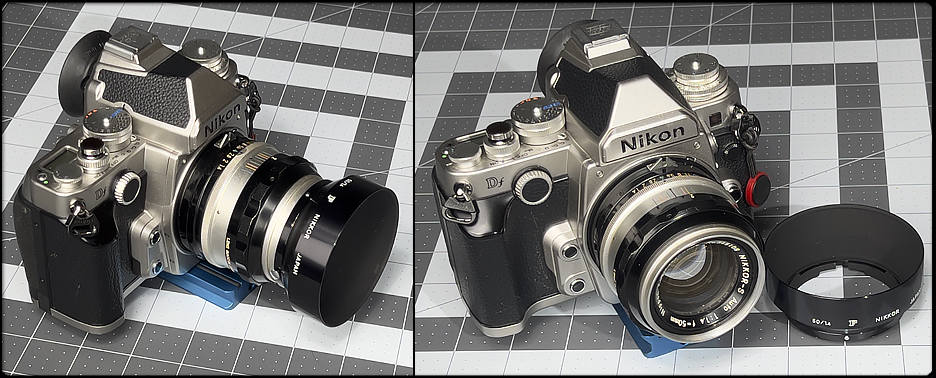
The Nippon Kogaku Nikkor-S 50mm f/1.4 is a historically significant lens that existed in two primary forms: the original rangefinder lens and the later SLR version. Nippon Kogaku (the original name of Nikon) released the Nikkor-S 5cm f/1.4 in 1950 for the Nikon S rangefinder system, where it became the world's first f/1.4 lens for 35mm photography. It was later adapted into the Nikkor-S Auto 50mm f/1.4 for the Nikon F SLR system in 1962, replacing the earlier 5.8cm f/1.4. • Production Year: 1962 • FOV: 46° • Min Focus: 24.0" • Aperture Scale: f1.4 to f16 • Filters: 52mm
• Dimensions: 67mm x 47.5mm • Weight: 320g • Lens Hood: Nikon 50 : 1.4
• Production Year: 1973 • FOV: 46° • Min Focus: 24.0" • Aperture Scale: f2.0 to f16 • Filters: 52mm
• Dimensions: 64.5mm x 48.0mm • Weight: 200g • Lens Hood: HS - 5
24 • Nikkor SC Fifties 50mm f1.4
The Nikkor 50mm f/1.4 S.C (often marked as 5cm) refers to a historically significant family of lenses from Nikon (formerly Nippon Kogaku) known for their fast aperture and distinctive "vintage" character. Depending on its design, it is likely one of two distinct versions: the 1950s rangefinder version or the 1970s SLR version. Rangefinder Version (1950s): Usually marked as 5cm f/1.4 S.C. It was the world's first f/1.4 lens for 35mm cameras. It comes in two primary mounts:• Nikon S-Mount: Native for Nikon rangefinder cameras like the Nikon S2.
• Leica Thread Mount (LTM/L39): A rare version used on Leica or Canon screw-mount cameras.
• SLR Version (1970s): Marked as Nikkor-S.C Auto 50mm f/1.4. This is a later F-mount lens for SLR cameras (like the Nikon F or F2). The "C" indicates it was one of the first Nikon lenses to feature multi-coating to reduce flare and improve contrast.
• Production Year: 1973 • FOV: 46° • Min Focus: XX.X" • Aperture Scale: f1.4 to f16 • Filters: 52mm
• Dimensions: 50,5mm x 63mm • Weight:200g • Lens Hood: 50 : 1.4

25 • Nikkor Fifties 50mm f1.2
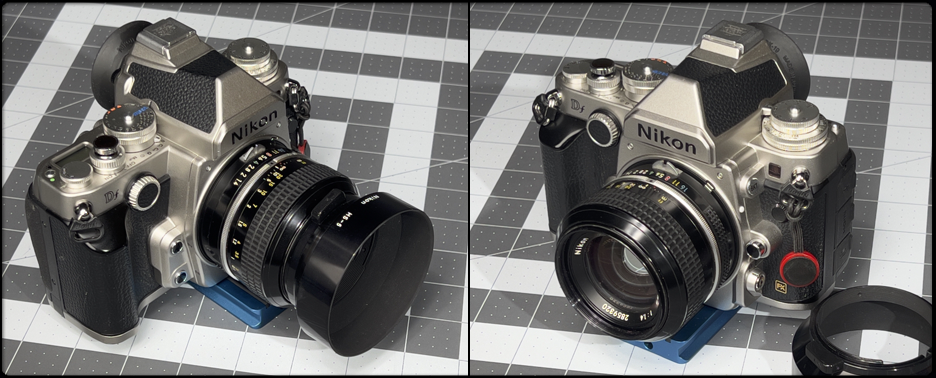
The Nikkor 50mm f/1.2 is Nikon's fastest manual-focus F-mount lens, celebrated for its unique rendering and solid "all-metal" build quality. Introduced in 1978, it remains a favorite for low-light photography and portraiture due to its ultra-shallow depth of field. The 50mm f/1.2 replaced the older 55mm f/1.2 design in 1978.• AI Version (1978–1981): The original release featured a 7-blade diaphragm and a longer focus throw, which some photographers prefer for critical manual focusing.
• AI-S Version (1981–Present): Introduced in September 1981, this version added a 9-blade diaphragm for smoother bokeh. It also featured a shorter focus throw for faster handling and is easily identified by its orange minimum aperture (f/16) marking.
• Production Status: Despite the shift to mirrorless, the AI-S version is reportedly still in limited production today, making it one of Nikon’s longest-running lens designs.
• Production Year: 2004 • FOV: 46° • Min Focus: 20.4" • Aperture Scale: f1.2 to f16 • Filters: 52mm
• Dimensions: 68.26mm x 47.27mm • Weight: 353.6g • Lens Hood: HS-12
26 • Nikkor Fifties 50mm f1.4
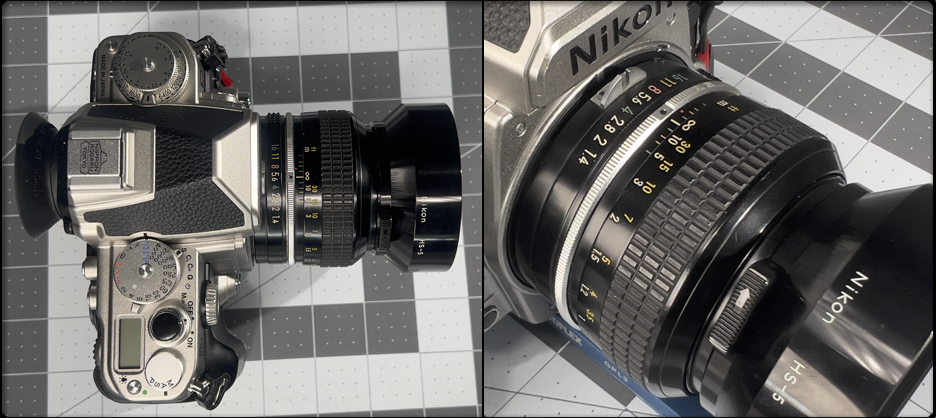
The Nikkor 50mm f/1.4 AI-s is a legendary manual-focus standard lens produced by Nikon from 1981 until 2020. Renowned for its all-metal construction and fast aperture, it was a staple for professional photographers for decades. • This lens is the refined culmination of Nikon’s 50mm f/1.4 lineage that began in 1962 with the Nikkor-S Auto.• AI-s Evolution: Introduced in September 1981, the "AI-s" version updated the previous AI (Automatic Indexing) system.
• Linear Aperture: AI-s lenses feature a linear aperture mechanism, allowing more precise control by the camera body for Program and Shutter Priority modes.
• Visual Identifiers: You can identify an AI-s version by the orange-colored minimum aperture (f/16) and a distinct semi-circular notch (scoop) in the lens mount.
• Production Year: 1975 • FOV: 46° • Min Focus: 18" • Aperture Scale: f1.4 to f16 • Filters: 52mm
• Dimensions: 40.6mm x 63.5mm • Weight: 000g • Lens Hood: Nikon 50/1.4
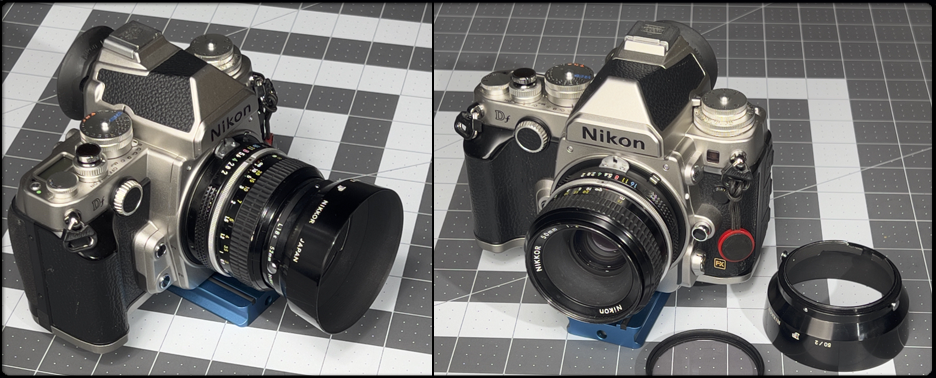
27 • Nikkor Fifties 50mm f2.0
The Nikkor 50mm f/2.0 (1959–1979) is a legendary, high-sharpness, all-metal "standard" lens for Nikon F-mount cameras, originally introduced alongside the Nikon F. Renowned for being compact, cheap, and durable, it features a 6-element, 4-group design. While later overshadowed by the 50mm f/1.8, the 50mm f/2 is favored for its sharp performance at f/2, sharp edges, and unique 6-bladed bokeh. History & Versions
• 1959–1972 (Nikkor-H Auto 50mm f/2): Introduced with the Nikon F, initially with a 0.6m close focus and single-coated optics.
• 1972–1974 (Nikkor-H·C Auto 50mm f/2): Introduced multi-coating (indicated by "C") to reduce flare.
• 1974–1977 (K-Series 50mm f/2): Updated cosmetic styling with rubberized focusing rings and improved close focusing to 0.45m.
• 1977–1979 (AI 50mm f/2): Introduced Aperture Indexing (AI) for automatic aperture indexing, allowing faster, easier mounting and metering.
• End of Production: Discontinued in 1979 when the 50mm f/1.8 took over.
• Production Year: 1974 - My First Lens! • FOV: 46° • Min Focus: 18" • Aperture Scale: f2.0 to f16 • Filters: 52mm
• Dimensions: 64.46mm x 38.59mm • Weight: 205.9g • Lens Hood: Nikon 50/2
• Nikkor Fifties +
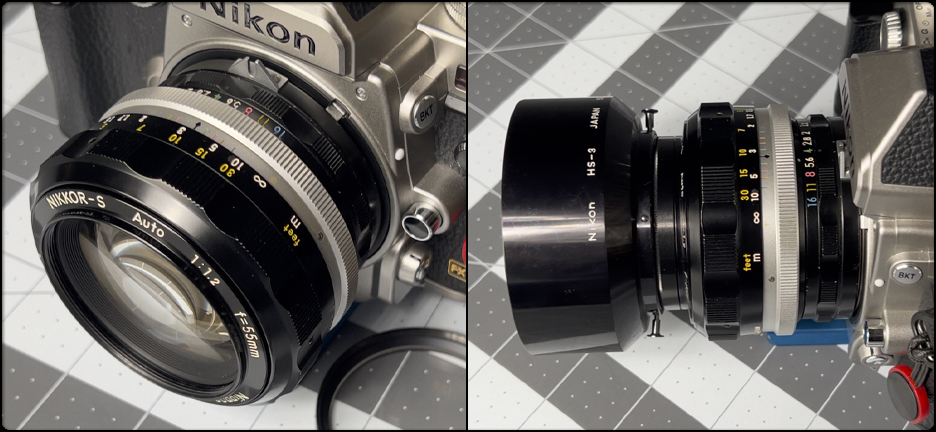
28 • Nippon Kogaku Fifties+ 55mm f1.2
The Nippon Kogaku Nikkor-S Auto 55mm f/1.2, introduced in December 1965, was Nikon’s first ultra-fast f/1.2 lens for the F-mount system. Designed by Yoshiyuki Shimizu, it utilized a 7-element Double Gauss-derived formula to achieve its high speed within the constraints of the 52mm filter diameter. The lens remained in production for approximately 13 years, undergoing several cosmetic and technical changes before being replaced by the 50mm f/1.2 in 1978. • Production Year: 1967 • FOV: 43° • Min Focus: 24.0" • Aperture Scale: f1.2 to f16 • Filters: 52mm
• Dimensions: 735.mm x 49.5mm • Weight: 420g • Lens Hood: Nikon 55/1.2
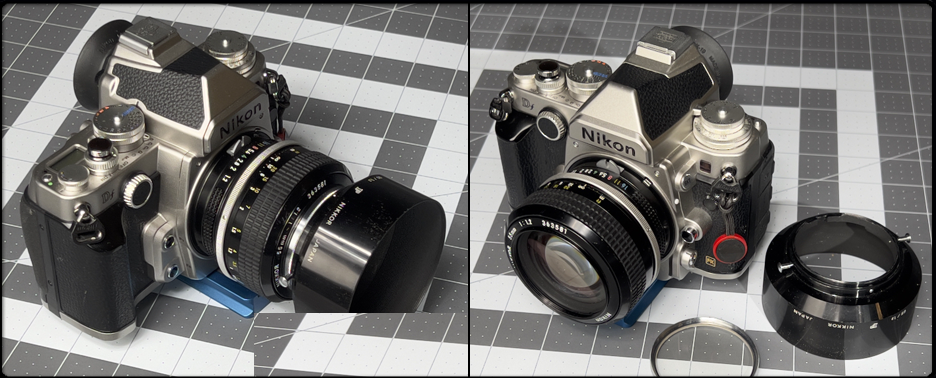
29 • Nikkor Fifties+ 55mm f1.2
The Nikkor 55mm f/1.2 was Nikon's first f/1.2 lens for the F-mount, introduced in December 1965 to provide extreme low-light performance and shallow depth of field. It remained a staple in Nikon's lineup for 13 years until it was succeeded by the 50mm f/1.2 in 1978.• Dreamy Aesthetics: Wide open at f/1.2, the lens is known for a "soft" or "dreamy" look with significant spherical aberration, making it popular for artistic portraiture.
• Sharpness: Center sharpness improves significantly when stopped down to f/2.8, becoming very sharp by f/4.
• Low Light: Designed for challenging conditions, its massive front element gathers substantial light, providing a bright viewfinder image for manual focusing.
• Production Year: 1974 • FOV: 43° • Min Focus: 20.4" • Aperture Scale: f1.2 to f16 • Filters: 52mm
• Dimensions: 72mm x 49.5mm • Weight: 410g • Lens Hood: HN-3
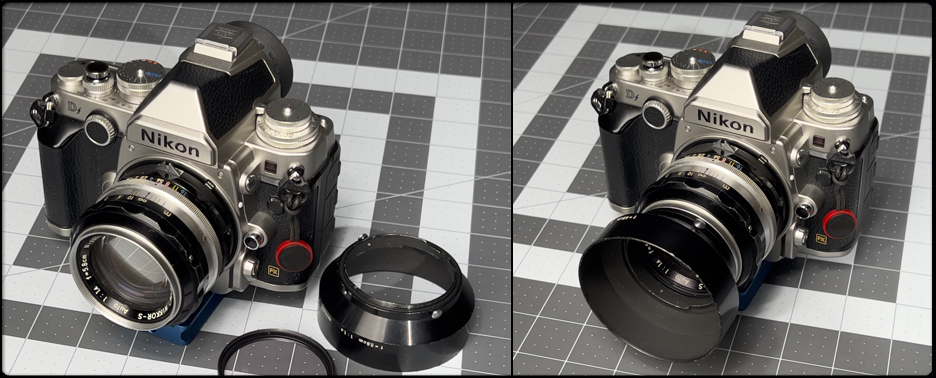
30 • Nippon Kogaku S Fifties+ 5.8cm f1.4
The Nippon Kogaku Nikkor-S Auto 5.8cm f/1.4 was Nikon's first f/1.4 aperture lens for the F-mount SLR system. Released in March 1960, it served as a "stop-gap" standard lens while engineers worked to overcome the technical challenges of designing a 50mm f/1.4 that could clear the SLR's reflex mirror.• Purpose: At the launch of the Nikon F in 1959, Nikon only had an f/2 5cm lens. To compete with Leica and other manufacturers, a faster f/1.4 lens was required.
• The 5.8cm Choice: Designers, led by Saburo Murakami, couldn't initially achieve an f/1.4 aperture at 50mm while maintaining the necessary "back focus" for mirror clearance. Increasing the focal length to 58mm (5.8cm) provided the extra space needed for the larger glass elements.
• Production: It had a short production run, starting in March 1960 and ending in January 1962 (replaced by the 50mm f/1.4). Roughly 39,000 to 40,000 units were produced.
• Legacy: Its unique 58mm focal length was later revived for the legendary Noct-Nikkor 58mm f/1.2 and the modern AF-S 58mm f/1.4G.
• Production Year: 1959 • FOV: 40.5° • Min Focus: 24.0" • Aperture Scale: f1.4 to f16 • Filters: 52mm
• Dimensions: 67mm x 58.8mm • Weight:356g • Lens Hood: HS-3
• Nikkor Portrait

31 • Nikkor Portrait 85mm f1.4
The Nikkor 85mm f/1.4 AI-S is a legendary manual-focus, short telephoto lens produced by Nikon from 1981 to 2006, widely regarded as a premier portrait lens. It was a staple in professional photography due to its high-speed aperture, which creates smooth "bokeh" and exceptional separation between the subject and background.• Release Date: September 1981 (AI-S version).
• Production Era: Manufactured for 25 years until 2006, continuing long after the introduction of autofocus (AF) alternatives in the 1990s, indicating its continued popularity.
• Design Philosophy: Developed by Takashi Takiguchi and Daijiro Fujie, this lens was designed for, and became the "It" lens for, portraiture and low-light work, offering a very bright viewfinder image.
• Key Innovation: It was the first Nikon telephoto lens to use the Close-Range Correction (CRC) system, allowing for high performance at close focusing distances.
• Production Year: 1990 • FOV: 28.3° • Min Focus: 33.46" • Aperture Scale: f1.4 to f16 • Filters: 72mm
• Dimensions: 72.5mm x 80.5mm • Weight: 609.1g • Lens Hood: HN-20mm
32 • Nikkor Portrait 85mm f1.8
The Nikkor-H Auto 85mm f/1.8 (introduced 1964) and its subsequent "K" (1975) and AI/AI-s iterations are renowned, classic manual focus portrait lenses featuring a 6-element, 4-group Gauss/Sonnar formula. Known for solid, all-metal construction and 52mm filter threads, they offer excellent sharpness and rendering for portraiture on vintage film and modern DSLRs, with a 430g weight and 0.85m-1m minimum focus.• Nikkor-H Auto (1964-1974): The original silver-nosed ("scoop") version, often found single-coated ("H") or later multi-coated ("H.C").
• "K" Series (1975-1977): The same optical formula but styled with rubberized focus rings to match the upcoming AI cameras.
• AI (1977-1979) / AI-s (1981): The lens was adapted to the Automatic Indexing (AI) system, which allowed for faster aperture coupling. Later, the 85mm f/2 replaced the 85mm f/1.8 in the lineup, making AI-s versions of the f/1.8 rarer or often AI-converted K/H lenses.
• Legacy: The 85mm f/1.8 was designed by Takashi Takiguchi, utilizing a unique convex meniscus-shaped air lens.
• Production Year: 1972 • FOV: 28.3° • Min Focus: 39.37" • Aperture Scale: f1.8 to f22 • Filters: 52mm
• Dimensions: 71.2mm x 76mm • Weight: 431.7g • Lens Hood: HN-7
33 • Nippon Kogaku Portrait 10.5cm f2.5 Zeiss Sonnar
The Nippon Kogaku 10.5cm f/2.5 Nikkor-P is a legendary portrait lens originally designed by Zenji Wakimoto in 1949 and released in late 1953. It is highly regarded for its "Sonnar-type" optical design, which it shared with Carl Zeiss lenses of that era.• Design Shift (1971): The lens was redesigned by Yoshiyuki Shimizu using a Xenotar-type formula (5 elements in 4 groups) to improve close-range performance and reduce aberrations.
• Production Year: 1967 • FOV: 23.2° • Min Focus: 48.0" • Aperture Scale: f2.5 to f32 • Filters: 52mm
• Dimensions: 66mm x 64.5mm • Weight: 370g • Lens Hood: Nikon 10.5cm
34 • Nikkor T 10.5cm f4.0
The Nikkor-T 10.5cm f/4.0, often nicknamed the "Mountain Nikkor," is a rare and compact manual focus telephoto lens initially released in 1960. Designed as an affordable and portable alternative to the professional 10.5cm f/2.5, it was marketed for hikers and travelers who needed high performance in a lightweight package.• Release & Purpose: Commercialized in the spring of 1960, the lens was part of Nikon's "three sacred treasures" of affordable interchangeable lenses, alongside the 3.5cm f/3.5 and 5cm f/2.
• The "Mountain" Nickname: It earned its moniker because of its visual similarity to the Leitz "Mountain Elmar" 10.5cm f/6.3.
• Production Context: Nikon introduced this lens to quickly fill the F-mount lineup after the launch of the Nikon F SLR; it was largely an adaptation of an earlier design for Nikon rangefinder (S-mount) cameras.
• Rarity: Approximately 5,000 units were produced before it was largely overshadowed by the faster f/2.5 version.
• Production Year: 1972 • FOV: 23.2° • Min Focus: 42.0" • Aperture Scale: f2.5 to f32 • Filters: 52mm
• Dimensions: 66mm x 68.5mm • Weight: 435g • Lens Hood: HS-4

35 • Nikkor P Portrait 105mm f2.5
The Nikkor-P 105mm f/2.5 is widely considered one of the greatest portrait lenses in history, famous for its exceptional sharpness and smooth bokeh. The "P" in its name stands for Penta, indicating its five-element optical construction. Xenotar (Gauss) Design (1971–2005): In 1971, Yoshiyuki Shimizu updated the lens to a 5-element, 4-group Xenotar-style design to improve performance at closer focusing distances. This design remained virtually unchanged for over 30 years and was used for the famous "Afghan Girl" portrait.• 1973: Multicoating was added, with lenses labeled as Nikkor-P·C.
• 1977: The AI (Auto Indexing) version was introduced, featuring a rubber focus ring and easier coupling with modern film SLRs.
• 1981: The AI-S version debuted with a built-in retractable lens hood.
• Production Year: 1972 • FOV: 23.2° • Min Focus: 42.0" • Aperture Scale: f2.5 to f32 • Filters: 52mm
• Dimensions: 66mm x 68.5mm • Weight: 435g • Lens Hood: HS-4
36 • Nikkor Portrait 105mm f1.8
The Nikkor 105mm f/1.8 AI-s was released in September 1981 as a faster, professional-grade alternative to the legendary 105mm f/2.5. At its launch, it was the fastest lens in its class, specifically designed for indoor sports and portraiture to coincide with the release of the Nikon F3.• Production Era: It was sold for approximately 12 years (standard retail life until roughly 1993), though some sources suggest limited availability continued until 2005.
• The Designer: The optics were designed by Teruyoshi Tsunashima, who achieved the impressive feat of maintaining an f/1.8 aperture using only a 5-element Xenotar-type design. This was a remarkable contrast to the 7-element designs typically required for such fast apertures.
• Production Year: 1981 • FOV: 23.2° • Min Focus: 36.0" • Aperture Scale: f1.8 to f22 • Filters: 62mm
• Dimensions: 71.2mm x 76mm • Weight:420g • Lens Hood: Built In
• Nikkor Telephoto 135mm to 500mm
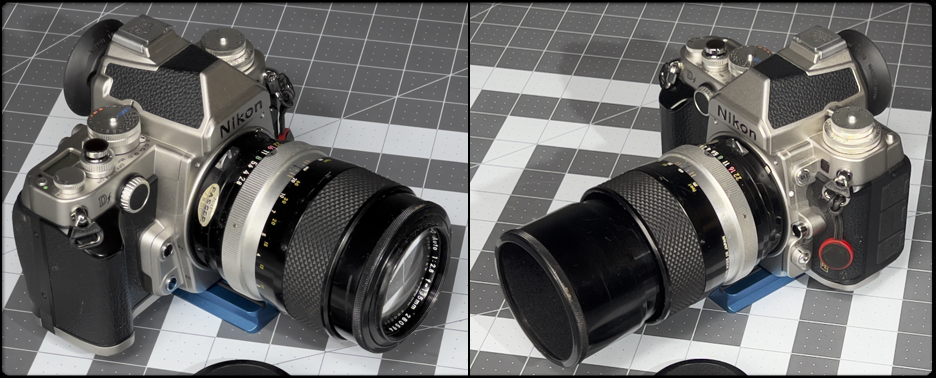
37 • Nikkor Q TelePhoto 135mm f2.8
The Nikkor-Q Auto 135mm f/2.8 is a classic medium telephoto lens first introduced by Nikon in 1964. It is widely recognized for its "simple" 4-element design (the "Q" stands for Quattuor, or four) which many photographers prize for its rich color saturation and distinct three-dimensional rendering.• Production Era: The original Nikkor-Q Auto 135mm f/2.8 was manufactured from 1964 to 1975.
◦ Nikkor-Q Auto (1964–1973): The early non-AI version with single coating.
◦ Nikkor-Q.C Auto (1973–1975): An updated version featuring Nikon Integrated Coating (NIC), often indicated by the "C" in the name, which improved flare resistance.
◦ Post-1975: Replaced briefly by the "New Nikkor" (K-type) before being updated to the AI and AI-s systems with a revised 5-element optical design.
• Compatibility: Most versions are "Non-AI" (Pre-AI), meaning they cannot be safely mounted on modern Nikon DSLRs without a conversion. However, they can be used with adapters on most modern mirrorless cameras.
• Production Year: 1968 • FOV: 18° • Min Focus: 5.0' • Aperture Scale: f2.8 to f32 • Filters: 52mm
• Dimensions: 66mm x 93.5mm • Weight: 455g • Lens Hood: Built In
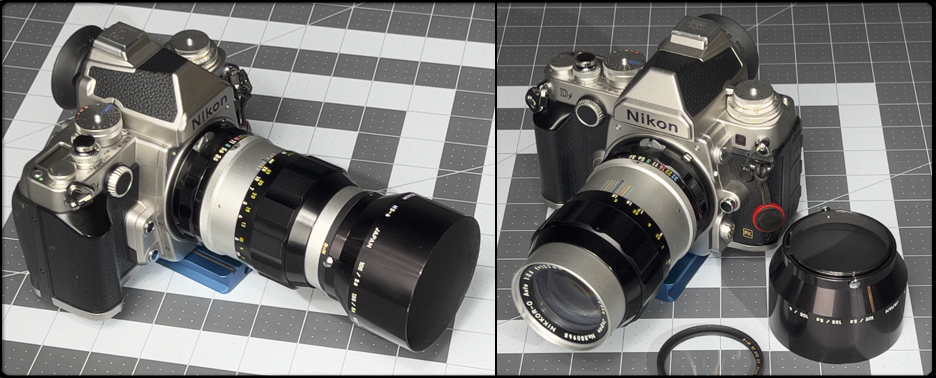
38 • Nikkor Q TelePhoto 135mm f3.5
The Nikkor-Q 135mm f/3.5 is a classic telephoto prime lens with a production history spanning from the late 1950s through the late 1970s. Known for its high build quality and sharp optics, it was a "budget-friendly" alternative to the faster f/2.8 models of its time.• Original Version (1959–1969): This early version is easily identified by the focal length being listed in centimeters (13.5cm) on the front ring rather than millimeters.
• Nikkor-Q Auto (1969–1979): The name was updated to 135mm, and the lens remained optically similar (4 elements in 3 groups) but saw mechanical refinements, such as moving from a 6-bladed to a 7-bladed diaphragm around 1969.
• Multicoating (1973): The Nikkor-Q.C version introduced multi-coating (signified by the 'C') to improve contrast and reduce flare, often featuring an all-black barrel.
• Successors: The "New Nikkor" (K) version appeared in 1975, followed by a completely redesigned AI version in 1977 that was more compact.
• Production Year: 1972 • FOV: 18° • Min Focus: 5.0' • Aperture Scale: f3.5 to f32 • Filters: 52mm
• Dimensions: 67mm x 85mm • Weight: 455g • Lens Hood: HS-4
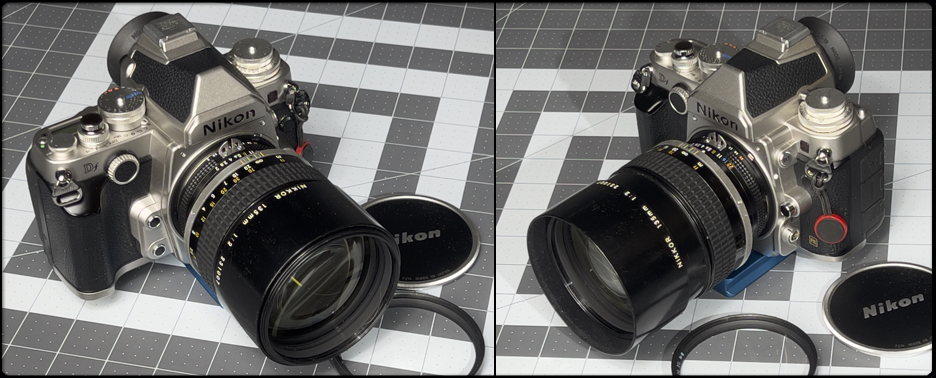
39 • Nikkor TelePhoto 135mm f2.0
The Nikkor 135mm f/2.0 is a legendary high-speed telephoto lens renowned for its exceptional build quality and its role as a "halo" portrait lens in Nikon's lineup. First introduced in 1975, it remained a staple in Nikon's manual-focus catalog for 30 years until being discontinued in 2005. The manual-focus 135mm f/2.0 shared the same 6-element optical design throughout its entire production run, designed by Sei Matsui, who also created the 180mm f/2.8.• Nikkor 135mm f/2 Auto IC (1975–1977): The first version, often referred to as the K-type. It featured the "New Nikkor" styling with a rubber focus ring but was a "Pre-AI" lens, requiring a prong to communicate aperture to the camera's meter.
• AI Nikkor 135mm f/2 (1977–1981): Upgraded with Automatic maximum aperture Indexing (AI), allowing it to couple automatically with the meters of modern Nikon SLRs and DSLRs.
• AI-S Nikkor 135mm f/2 (1981–2005): The final manual-focus version. It introduced a modified diaphragm mechanism for improved automatic exposure on cameras like the Nikon FA. While optically identical to previous versions, it featured a slightly shorter focus throw (200° vs 270°) and a longer built-in hood.
• Production Year: 1981 • FOV: 18° • Min Focus: 4.50' • Aperture Scale: f2.0 to f22 • Filters: 72mm
• Dimensions: 81mm x 94mm • Weight: 860g • Lens Hood: Built In
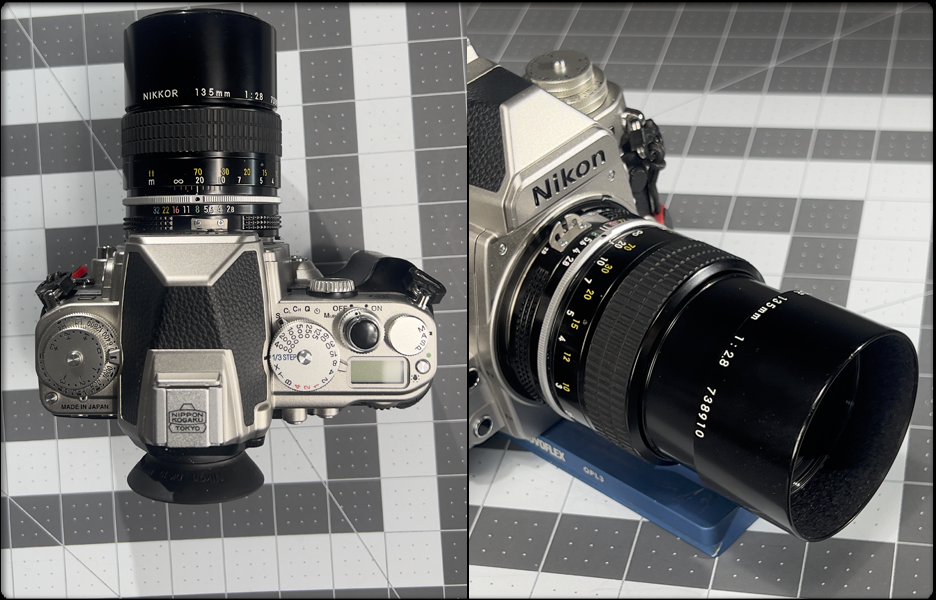
40 • Nikkor TelePhoto 135mm f2.8
The Nikkor 135mm f/2.8 AI is a classic manual focus telephoto lens produced by Nikon, known for its compact size, robust all-metal build, and excellent performance for portraits and general photography. Introduced around 1977 as part of the AI (Automatic Indexing) series, it replaced older pre-AI designs and was later followed by the AI-s version in 1981, which was produced until 2005.• Evolution: This lens evolved from the older 135mm f/2.8 Nikkor-Q (4-element design). The updated 5-element design, which features a more compact optical formula, was introduced in 1976 and soon updated to AI, then to AI-s.
• AI Version (1977-1981): Introduced to work with the new AI metering system, allowing quick, automatic aperture indexing with cameras like the Nikon F2, FM, and FE.
• AI-s Version (1981-2005): The AI-s version (often branded as Nikkor 135mm f/2.8 AI-s) brought subtle improvements like a different diaphragm mechanism for auto-exposure with the Nikon FA, slightly faster focusing gearing, and a built-in telescopic hood.
• Production Legacy: It is considered a popular, successful lens with a 24-year production run for the AI-s variant.
• Production Year: 1976 • FOV: 18° • Min Focus: 4.26' • Aperture Scale: f2.8 to f32 • Filters: 52mm
• Dimensions: 72.5mm x 96mm • Weight: 620g • Lens Hood: Built In
41 • Nikkor P TelePhoto 180mm f2.8
The Nikkor-P Auto 180mm f/2.8 was a landmark lens for Nikon, originally introduced in 1970 for the press and released to the general public in 1971. The "P" in its name stands for Penta, referring to its 5-element optical construction. It was the first modern 180mm f/2.8 prime in the Nikon F-mount lineup, favored for sports and stage photography due to its fast aperture and relatively compact design for the era.• Origin: Designed by Mr. Sei Matsui, it was his first interchangeable lens for the Nikon F system. It replaced the much larger and heavier 18cm f/2.5 rangefinder lens.
• Nikkor-P Auto (1970–1974): The original Non-AI manual focus version.
• Nikkor-P·C Auto (1975–1977): Added multi-coating (indicated by the "C") to improve flare resistance and contrast.
• AI Nikkor (1977–1981): Updated with Automatic Maximum Aperture Indexing (AI) to work with newer camera meters, but used the same 5-element/4-group .
• Successors: In 1981, it was replaced by the 180mm f/2.8 ED AI-s, which introduced Extra-low Dispersion (ED) glass and a 5-element/5-group design for even higher image quality. The Nikkor-P Auto 180mm f/2.8 was a landmark lens for Nikon, originally introduced in 1970 for the press and released to the general public in 1971. The "P" in its name stands for Penta, referring to its 5-element optical construction. It was the first modern 180mm f/2.8 prime in the Nikon F-mount lineup, favored for sports and stage photography due to its fast aperture and relatively compact design for the era.
• Origin: Designed by Mr. Sei Matsui, it was his first interchangeable lens for the Nikon F system. It replaced the much larger and heavier 18cm f/2.5 rangefinder lens.
• Production Year: 1971 • FOV: 13.4° • Min Focus: 6.0' • Aperture Scale: f2.8 to f32 • Filters: 72mm
• Dimensions: 81mm x 133mm • Weight: 880g • Lens Hood: Built In

42 • Nikkor TelePhoto ED 180mm f2.8
The Nikkor 180mm f/2.8 ED is a legendary telephoto lens series known for introducing Extra-low Dispersion (ED) glass to more accessible lens tiers. Since its debut in 1970, it has evolved through several manual and autofocus iterations, consistently prized for its sharpness and compact size. The lineage of the 180mm f/2.8 is defined by its transition from high-performance manual glass to sophisticated autofocus optics.Pre-ED Era (1970–1981):
• Nikkor-P Auto (1970/1971): The first modern version, designed by Sei Matsui, featured a 5-element, 4-group Ernostar design.
• AI Version (1977): Updated with Nikon's Automatic Indexing system and improved coatings.
ED Manual Era (1981–2006):
• Nikkor 180mm f/2.8 ED AI-s: Released in 1981, this "epoch-making" lens was the first medium telephoto to use ED glass. It is identified by a narrow
• Production Year: 1971 • FOV: 13.4° • Min Focus: 6.0' • Aperture Scale: f2.8 to f32 • Filters:72mm
• Dimensions: 78.5mm x 130mm • Weight:800g • Lens Hood: Built In
43 • Nippon Kogaku Q TelePhoto 20cm f4.0
The Nippon Kogaku Nikkor-Q 20cm f/4.0 (later renamed to the 200mm f/4) was a landmark lens released in 1961 as the first full-scale telephoto lens for the Nikon F-mount to feature a fully automatic aperture mechanism.• Original Release: Debuted in 1961 as the tenth lens in the Nikon F system lineup.
• Designation: Early models were marked in centimeters (20cm) before Nikon switched to millimeters (200mm) around 1966–1967.
• "Q" Meaning: The "Q" stands for Quattuor, indicating a four-element optical design.
• Early Versions (1961–1967): Featured a 6-blade diaphragm and focused only to 3 meters (10 feet).
• Remodeled Versions (1967–1973): Improved optical performance and resolving power, with minimum focusing distance reduced to 2 meters (7 feet).
• "C" Version (1973): Introduced multi-coating (NIC) to improve flare resistance and contrast.
• Replacement: It was succeeded in 1976 by the more compact "New Nikkor" (K-type) 200mm f/4, which utilized a 5-element design.
• Production Year: 1961 • FOV: 2.2° • Min Focus: 7.0' • Aperture Scale: f4.0 to f22 • Filters: 52mm
• Dimensions: 73mm x 153.5mm • Weight: 560g • Lens Hood: Built In
44 • Nikkor TelePhoto 200mm f4.0
he Nikkor 200mm f/4 telephoto lens has a legacy spanning over 35 years (1961–1996), evolving through three primary mechanical and optical generations. Originally a flagship telephoto for the Nikon F system, it later became a staple compact "travel" lens known for its sharp optics and portability. The 200mm f/4 was a critical lens in popularizing SLRs by making telephoto shooting practical and relatively lightweight.
• Nikkor-Q Auto Era (1961–1976): The first full-scale 200mm F-mount lens with an automatic aperture. Early models (marked in "cm") focused to 3m, while later versions (marked in "mm") improved focus to 2m and added multicoating (the "C" designation) in 1973.
• The "K" & AI Redesign (1976–1981): A complete optical and mechanical overhaul. Designer Teruyoshi Tsunashima created a more compact, 5-element design without using expensive ED glass to keep it accessible for enthusiasts. The AI version (1977) added Automatic Indexing for modern metering.
• AI-S Era (1981–1996): This was a mechanical refresh of the AI version with the same 5-element optics. It is the most compact version and features more rounded aperture blades to improve bokeh.
• Production Year: 1975 • FOV: 12.2° • Min Focus: 7.0' • Aperture Scale: f4.0 to f32 • Filters: 52mm
• Dimensions: 68mm x 118mm • Weight: 540g • Lens Hood: Built In

45 • Nikkor TelePhoto ED IF 300mm f2.8
The Nikkor 300mm f/2.8 ED-IF was introduced in November 1977 as the world’s first practical super-speed telephoto lens for general users. It was a landmark achievement that brought Extra-low Dispersion (ED) glass and Internal Focusing (IF) to the forefront of professional photography, establishing the "3, 2-8" (San, Ni-Ppa) legacy that remains iconic today.• 1972 (The Prototype): A limited "pre-ED" version (NIKKOR-H 300mm f/2.8) was released exclusively for press use at the Sapporo Winter Olympics. Only about 100–150 units were produced.
• 1977 (Commercial Launch): The AI Nikkor 300mm f/2.8 ED-IF was released to the public. It was the first production model to feature both ED glass to eliminate chromatic aberration and an internal focusing system.
• 1982–1985 (AI-S Updates): The lens was updated to AI-S specifications. A 1985 revision added a permanent protective front filter and improved the close-focusing distance from 4m (13.1 ft) to 3m (9.8 ft).
• Production Year: 1988 • FOV: 8.1° • Min Focus: 13.0' • Aperture Scale: f2.8 to f22 • Filters: 39mm Tray
• Dimensions: 138mm x 241mm • Weight: 2500g • Lens Hood: HE-4
46 • Nikkor TelePhoto ED IF 300mm f4.5
The Nikkor 300mm f/4.5 ED-IF is a legendary manual focus lens celebrated for its sharp optical performance and exceptionally compact, lightweight design. Introduced in August 1978, it was the first 300mm Nikkor to combine Extra-low Dispersion (ED) glass with an Internal Focusing (IF) system, making it significantly more agile than its predecessors. The lens represents the final evolution of Nikon’s 300mm f/4.5 prime series, which began in 1964.• Early Roots (1964–1977): The original non-ED models were often criticized for chromatic aberration and poor color rendition.
• The ED Breakthrough (1977): Nikon introduced a version with ED glass but without internal focusing. It improved sharpness but remained large and heavy.
• The ED-IF Revolution (1978–1999): In 1978, the ED-IF version debuted with a new optical formula (7 elements in 6 groups). This allowed the lens to stay the same length while focusing and reduced the minimum focus distance from 13 feet to just 8.2 feet.
• Variants: While the AI version arrived in 1978, the AI-S version (released Dec 1982) is more common today and features an improved 9-blade diaphragm for smoother bokeh.
• Production Year: XXXX • FOV: XX.X° • Min Focus: XX.X" • Aperture Scale: fxxx to fxxx • Filters: 52mm
• Dimensions: xxmm x xxmm • Weight: 000g • Lens Hood: 52mm
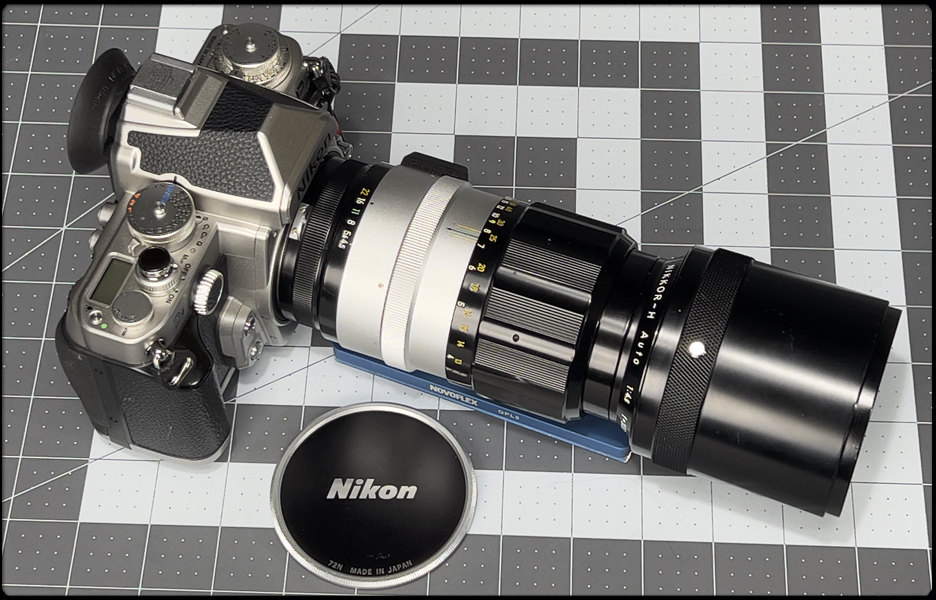
47 • Nikkor Q Telephoto 300mm f4.5
The Nikkor 300mm f/4.5 has a long history spanning nearly four decades, evolving from the original Nikkor-P Auto in 1964 to the highly regarded ED-IF AI-S version that remained in production until 1999.The lens went through several optical and mechanical redesigns:
• Nikkor-P Auto (1964–1969): The first 300mm for the Nikon F system, featuring 5 elements in 5 groups. Early models had fixed tripod mounts.
• Nikkor-H Auto / Pre-AI (1969–1977): Updated to 6 elements in 5 groups to improve color balance and reduce chromatic aberration. Later "New-Nikkor" versions (c. 1975) introduced rubberized focus rings and a modern black finish.
• Nikkor ED (1977–1978):* Introduced Extra-low Dispersion (ED) glass to combat color fringing, using 6 elements in 5 groups.
• Nikkor ED-IF (1978–1999):* A radical redesign using Internal Focusing (IF), which allowed for much faster handling and a significantly shorter minimum focus distance of 2.5m (8.2 ft) compared to the previous 4m (13 ft).
• Production Year: 1971 • FOV: 8-10° • Min Focus: 13.0 ft • Aperture Scale: f4.5 to f32.0 • Filters: 72mm
• Dimensions: 80mm x 199mm • Weight:980 • Lens Hood: Built In
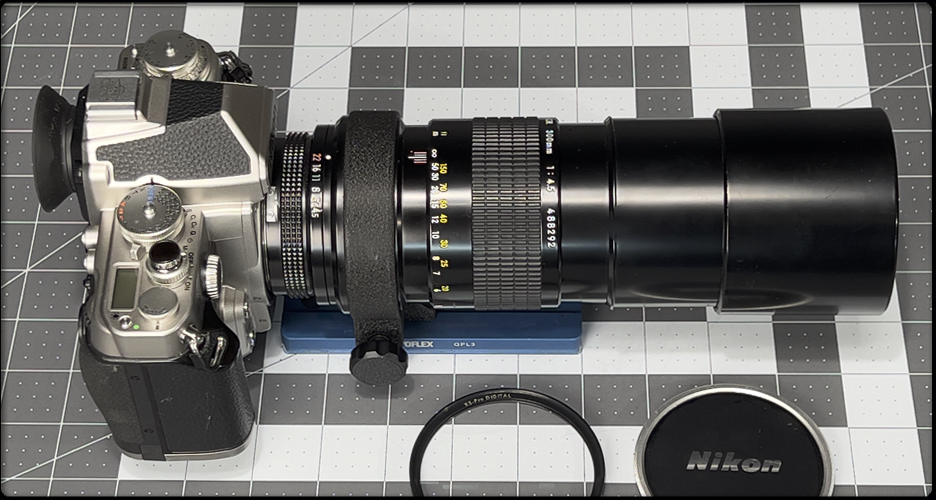
48 • Nikkor K Telephoto 300mm f4.5
The Nikkor 300mm f/4.5 "K" (also known as the "New Nikkor") is a manual focus telephoto lens produced by Nikon between 1975 and 1977. It was a pivotal cosmetic update that replaced the older scalloped-metal "Nikkor-H" design with a modern, all-black exterior and a rubberized focusing ring, a look that defined Nikon lenses for decades.• It followed the Nikkor-H Auto (1969), keeping the same improved 6-element optical formula while introducing modern styling and multi-coating (NIC) to reduce flare.
• The "K" version is a Pre-AI (Non-AI) lens, meaning it uses the classic "rabbit ears" prong for meter coupling and requires a simple factory or third-party modifications.
• Transition: It was shortly followed by the AI version in 1977, which shared the same optics but introduced automatic maximum aperture indexing.
• Production Year: 1975 • FOV: 8-10° • Min Focus: 13.0 ft • Aperture Scale: f4.5 to f32 • Filters: 72mm
• Dimensions: 78.5mm x 203mm • Weight:1140g • Lens Hood: Built In
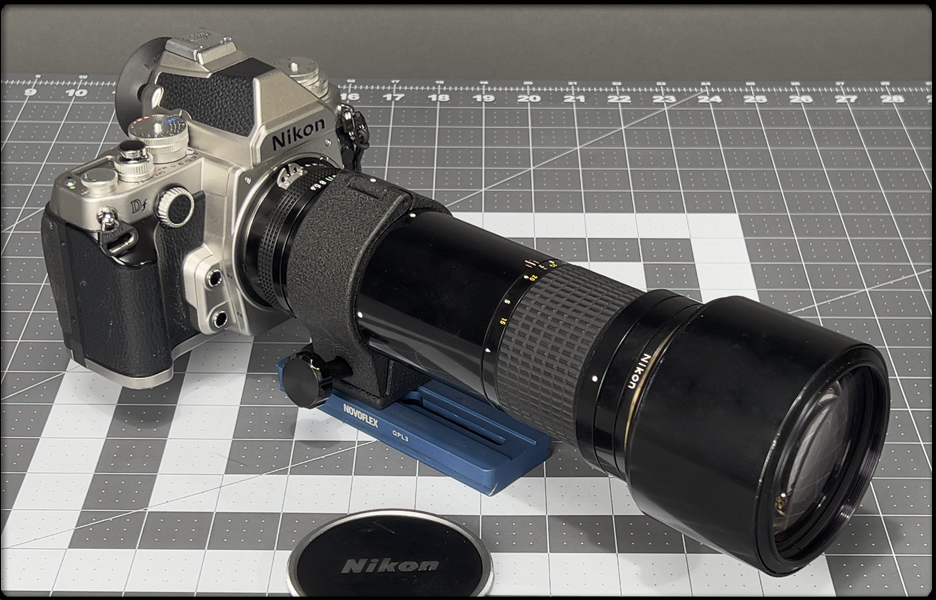
49 • Nikkor Telephoto ED 400mm f 5.6
The Nikkor 400mm f/5.6 ED is a historically significant, compact manual-focus telephoto lens produced by Nikon between 1973 and 2002. Renowned for its sharpness and inclusion of Extra-low Dispersion (ED) glass to eliminate chromatic aberration, it came in several versions, including the popular Internal Focusing (IF) Ai-S model. The lens is known for high contrast, excellent sharpness even at wide open f/5.6, and rugged all-metal construction. The IF (Internal Focusing) design allows for faster, smoother focusing compared to earlier non-IF, standard focusing designs. It is known to perform well with teleconverters like the TC-300. • Production Year: 1984 • FOV: 6-10° • Min Focus: 13.0 ft • Aperture Scale: f5.6 to 32.0 • Filters: 72mm
• Dimensions: 85mm x 262mm • Weight: 1260g • Lens Hood: Built In
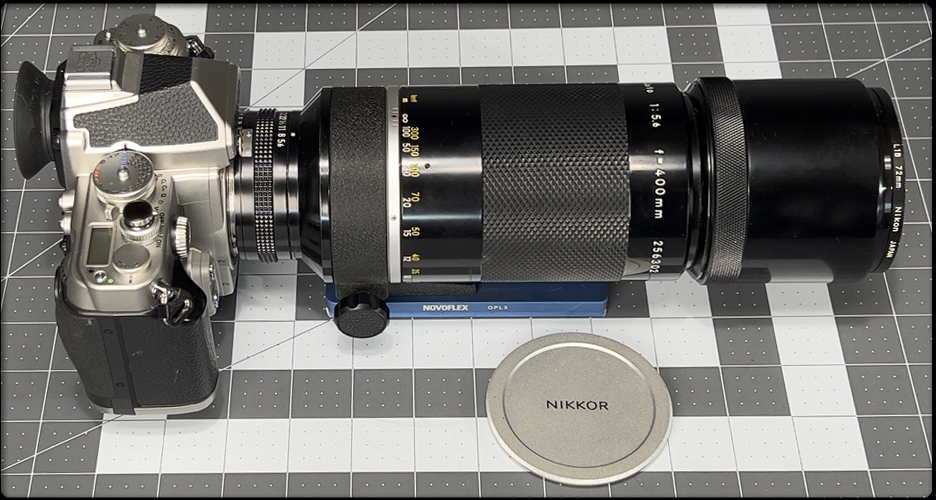
50 • Nikkor PC Kai Fat Telephoto 400mm f5.6
The Nikkor-P•C Auto 400mm f/5.6 is a notable super-telephoto lens in Nikon's history, primarily recognized for being the first to unofficially use Extra-Low Dispersion (ED) glass to combat chromatic aberration. Introduced in 1973, it was designed to offer a lighter, more compact alternative to the massive 400mm f/4.5 lenses of the 1960s.• The "Special Glass" Debut (1973): The lens was first advertised at Photokina 1973. While it was not officially branded as an "ED" lens and lacked the iconic gold ring of later models, it was marketed as using "special glass" to provide professional-grade sharpness.
• The "Kai Fat" Connection: In collector circles, the term "Kai Fat" or "Fat" refers to the earlier non-internal-focusing (non-IF) versions of the 400mm f/5.6. These lenses have a thicker, more substantial barrel compared to the slender, internal-focusing (IF) version that replaced them in 1978.
• Production Year: 1974 • FOV: 6-10° • Min Focus: 16.9 ft • Aperture Scale: f5.6x to f32.0 • Filters:72mm
• Dimensions: 84.5mm x 255mm • Weight: 1400g • Lens Hood: Built In
51 • Nikkor Telephoto ED IF 500mm f4.0 Ai-s with Hard Case - Leather Cap
The Nikon Nikkor 500mm f/4 P IF-ED is a professional manual-focus super-telephoto lens renowned for bridging the gap between manual-focus optics and modern digital metering. Released in 1988 and produced until approximately 2005, it was the first Nikkor lens to feature an "AI-P" interface—a built-in CPU that allows it to communicate aperture and exposure data to modern Nikon SLR and DSLR bodies.• A "Bridge" Lens: While Nikon was transitioning to autofocus in the late 1980s, professional telephotos like the 500mm f/4 initially remained manual-focus due to technical challenges with moving large glass elements quickly.
• Introduction: It was announced in late 1987 as a replacement for the older 500mm f/4.5.
• Longevity: Despite the release of the autofocus AF-I version in 1994 and AF-S in 1996, the manual-focus P-type remained in production for nearly 17 years due to its high optical quality and lower cost compared to exotic AF models.
• Production Year: 0000 • FOV: 000° • Min Focus:00.0" • Aperture Scale: f2.8 to f22.0 • Filters: 39mm Rear - L1BC, 056, A2, and B2
• Dimensions: 000mm x 000mm • Weight: 0000g • Lens Hood N/A

360icon • The Old Creepy House Explorers Club
Rural Photographic Exploring and Visual Documentation • Since 2007
All Elses Passes • Art Alone Endures.
K.Durk • Copyright 2007-2056 All Rights Reserved
